
Construction firm reduced RFIs by 35% with coordinated LOD 450 BIM modeling
Industry: Commercial construction
Project Type: Departmental store development
Services Delivered: Multi-disciplinary BIM coordination, LOD 450 BIM modeling, clash detection & constructability validation
Project Size: 3,73,425 Sq. Ft.
Software Used: Autodesk Revit, Navisworks
LOD Level: LOD 450
Customer story
A leading construction firm partnered with ReviCAD for BIM coordination support on a large-scale departmental store project spanning over 3,73,425 sq. ft. As the project moved deeper into construction planning, coordination between architectural, structural, and MEP systems started becoming increasingly complex, especially with multiple teams working simultaneously under tight deadlines.
The client needed more than just a detailed BIM model. They were looking for a coordination partner who could help reduce RFIs, improve constructability, and make sure project teams had reliable, up-to-date information throughout execution.
Like many fast-track commercial projects, design revisions were still happening during advanced stages of coordination. This created gaps between disciplines and increased the chances of clashes, clarification requests, and rework during construction. Teams needed a better way to coordinate updates across trades without slowing down the overall project schedule.
That’s where ReviCAD stepped in.
The challenge
As the project progressed, keeping different disciplines aligned became more difficult. Structural and MEP systems were evolving in parallel, and even small design updates had the potential to impact multiple trades downstream.
The client was also dealing with tight BIM delivery timelines that needed to stay aligned with ongoing construction activities. Without a centralized coordination workflow, there was a growing risk of RFIs, field conflicts, and installation delays once work reached the site. Some of the major project challenges included:
- Frequent design changes during advanced project stages
- Coordination gaps between structural and MEP systems
- Lack of a centralized workflow for clash detection and validation
- Increasing RFIs caused by inconsistencies across disciplines
- Tight BIM delivery schedules tied to construction timelines
- Higher risk of clashes and coordination-related rework on-site
- Need for fabrication-level BIM detail at LOD 450
- Difficulty validating constructability before installation
The client needed a coordinated BIM environment where every discipline could work with updated information while minimizing coordination issues during execution.
The solution
ReviCAD Solutions developed a progressive BIM coordination workflow tailored specifically for the project’s fast-moving construction requirements.
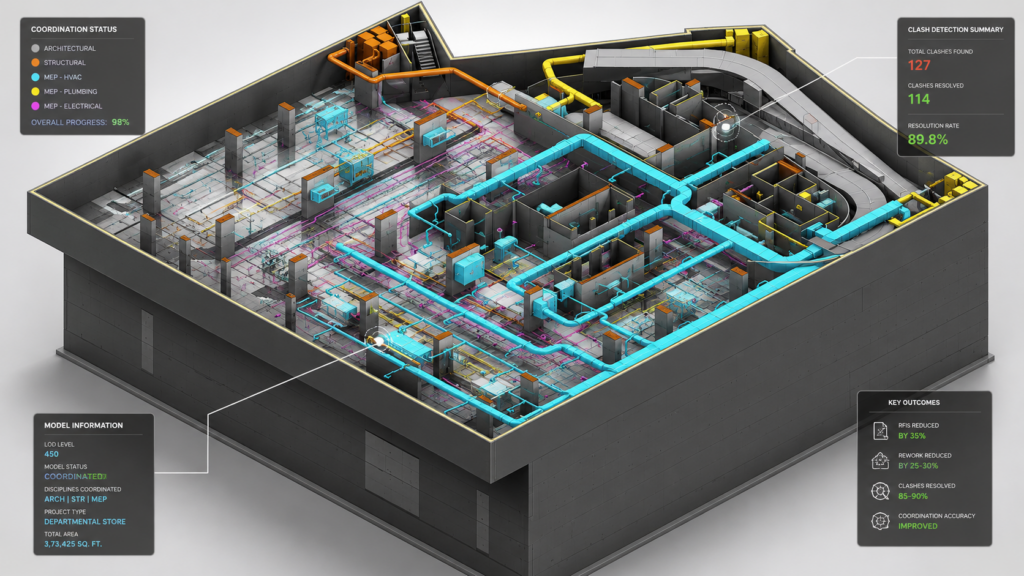
The team created a detailed LOD 450 BIM model integrating architectural, structural, and MEP systems within a unified Revit environment. But the focus wasn’t only on model accuracy. The goal was to make the model practical for real construction workflows, something site teams, coordinators, and fabrication teams could actually use during execution.
Using Navisworks, the ReviCAD team carried out clash detection and multi-disciplinary coordination to identify conflicts early, before they became on-site problems. Progressive validation workflows were also introduced so that every major design update could be reviewed and coordinated across disciplines before being added into the master model.
To support construction teams further, ReviCAD delivered coordinated layouts, annotated documentation, schedules, and model-based quantity information that helped improve visibility during planning and installation activities.
The collaborative approach made a noticeable difference. Instead of reacting to coordination problems later in the project, teams were able to identify and resolve issues much earlier in the workflow.
Business impact
The coordinated BIM workflow helped the client improve project coordination across disciplines while reducing many of the issues that typically slow down construction projects during execution.
By resolving clashes earlier and maintaining a centralized BIM coordination process, project teams were able to work with better visibility and fewer coordination uncertainties throughout the construction phase.
Key Outcomes
- Reduced RFIs and coordination queries during execution by approximately 35%
- Resolved nearly 85–90% of major coordination clashes before construction execution
- Accelerated BIM coordination and model delivery timelines by approximately 20–25%
- Reduced on-site rework and coordination-related modifications by nearly 30%
- Improved fabrication accuracy by approximately 20% through detailed LOD 450 model outputs
- Improved construction sequencing and planning for site teams
- Enhanced collaboration between architectural, structural, and MEP disciplines
- Delivered a coordinated, construction-ready BIM environment aligned with execution requirements
By the time the final coordinated model was delivered, the client’s teams had much better visibility into installation sequencing, coordination dependencies, and potential execution risks. It also helped improve communication between trades during critical construction stages.
Why this project matters
Large-scale commercial projects demand more than just detailed BIM models, they require coordinated digital workflows that support real-world construction execution.
This project demonstrates ReviCAD’s ability to manage complex, multi-disciplinary BIM coordination assignments while balancing constructability, accuracy, and fast-paced project timelines.
By combining LOD 450 modeling expertise with structured coordination and validation workflows, ReviCAD helped transform design intent into practical, construction-ready digital intelligence that supported smoother execution on-site.