



[vc_row][vc_column][vc_column_text css=””]
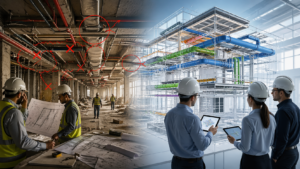
Construction waste has long been one of the more stubborn inefficiencies in the AEC industry. Estimates indicate that traditional building methods often discard up to 30% of materials on-site or through rework, over-ordering, and poor coordination. The good news is that today, effective BIM implementation is increasingly recognised not just for design and visualization benefits, but as a measurable driver of waste reduction, cost savings, and sustainable construction.
In this article, we’ll explore how BIM implementation contributes to reducing waste on construction sites — from early design stages to demolition and circular economy strategies — backed by up-to-date data, real-world insights, and actionable considerations for AEC firms and BIM adopters.
[/vc_column_text][vc_column_text css=””]
The Waste Challenge in Construction
Before diving into how BIM helps, it’s worth revisiting the scale of the problem. Construction and demolition (C&D) waste accounts for a large portion of a project’s material inefficiencies and often translates directly into lost margin, time delays, environmental impact, and reputational risk.
- One recent source states that construction projects can waste nearly 30% of their materials — meaning almost one-third of budgeted material ends up in landfills or unused stock.
- Because of poor coordination, ordering excess, rework due to clashes and design errors, many firms still treat waste as a cost of doing business rather than a controllable metric.
- Waste in materials also means embedded carbon and embodied energy being wasted — not just the immediate dollar cost.
Given that backdrop, BIM implementation becomes more than a software choice — it becomes a strategic capability to tackle waste head-on.
[/vc_column_text][vc_column_text css=””]
What We Mean by BIM Implementation
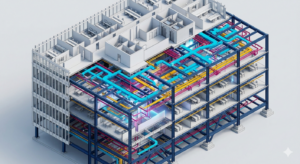
When we say “BIM implementation,” we refer to the holistic deployment of Building Information Modeling workflows, standards, roles, data-sharing mechanisms, coordination processes, and lifecycle thinking throughout a project (and ideally across an organization). It is not simply using a 3D tool; it is embedding BIM into the way design, engineering, procurement, fabrication, construction, and even operations are managed.
Effective BIM implementation for waste reduction incorporates things such as:
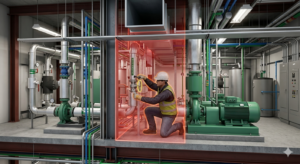
- Early design collaboration and clash detection
- Accurate quantity take-offs and material ordering
- Prefabrication or off-site manufacture linked to BIM models
- Simulation of construction sequences (4D/5D) to optimise logistics and minimise scraps
- Lifecycle data use (6D) for deconstruction, reuse, recycling, and circular flows
- Continuous improvement of BIM standards, team role,s and knowledge transfer
With that in mind, let’s look at how BIM implementation translates into tangible waste-reduction benefits.
[/vc_column_text][vc_column_text css=””]
Key Waste-Reduction Mechanisms Enabled by BIM Implementation
Here are the major levers through which BIM implementation reduces waste in construction projects, with supporting evidence.
1. Early clash detection, design-error avoidance & fewer reworks
One of the most effective ways BIM implementation reduces waste is by preventing problems upfront rather than reacting to them on-site. For example:
- A BIM-based waste estimation study found that using clash detection in the BIM model could prevent 40-45% of construction waste that otherwise might have occurred due to design errors or changes.
- Another review showed BIM use could reduce C&D waste management costs by up to 57% compared to conventional methods.
- In practical case studies, combining BIM with prefabrication and planned sequencing yielded on‐site waste generation rates between 15-45% lower than traditional benchmarks.
By catching clashes, optimizing sequencing, and aligning disciplines early, BIM implementation ensures the design intent is carried forward accurately to construction, reducing non-value tasks, off-cuts, and scrap.
2. Accurate quantity take-offs and optimised material ordering
When models are rich with information (quantities, materials, assemblies) and federated early, BIM implementation helps avoid over-ordering, material redundancies, and unnecessary stock. A few key insights:
- BIM workflows enable judicious ordering of materials through reliable quantification and linking to procurement/fabrication.
- Studies focused on formwork waste found that prefabrication driven by BIM models reduced formwork waste by ~59.7% to 71.8%.
In short: Better data → less guesswork → less waste.
3. Prefabrication / off-site manufacture enabled via BIM
One of the strongest waste-reduction sources is shifting work off-site and fabricating assemblies in controlled environments — something BIM implementation fosters through accurate modelling and coordination.
- The research shows significant waste reduction when BIM is combined with prefabrication, since on‐site cutting, fitting, rework, and scraps are substantially reduced.
- As supply-chain and fabrication processes integrate with BIM, off-cuts waste and rework drop markedly.
4. Waste prediction modelling, circular economy & digital twin integration
Looking into the future, BIM implementation is no longer limited to design/construction phases — it now extends into lifecycle thinking, demolition reuse, and circular economy workflows.
- A 2025 paper highlights a BIM-based digital twin framework for demolition waste management, enabling estimation of carbon emissions and facilitating reuse/recycle scenarios.
- Another study on circular economy in construction describes BIM as a foundational enabler for material passports, component reuse, digital twin integration, and waste minimisation.
- These trends show that advanced BIM implementation is enabling “design-for-deconstruction”, reuse flows and material re-entry — going beyond simply “less waste” to “waste as resource”.
5. Project schedule compression and lean logistics
Efficient BIM implementation also helps reduce project duration, coordination lags, and logistic inefficiencies — which indirectly reduce waste (material, labour, time).
- For example, modern research notes reductions in project duration of around 6-10% via BIM‐enabled prefabrication and scheduling.
- Fewer delays, fewer on-site changes, and fewer material idle times all contribute to lower waste.
[/vc_column_text][vc_column_text css=””]
Recent Data and Metrics in BIM Implementation for Waste Reduction
Here are some of the latest quantified impacts associated with BIM implementation in waste reduction (2023-25 era):
- Up to 25-30% reduction in material waste (via predictive modelling, material tracking, circular design).
- Landfill waste diversion of up to 99% in exemplar projects (e.g., via BIM‐enabled simulation and coordination).
- Cost savings of 15-20% tied to optimized resource use and reduced rework.
- Formwork waste reductions of circa 60-70% when BIM and prefabrication are aligned.
- Waste reduction via BIM prediction modelling and sequencing simulation (recent Canadian study, 2024).
These numbers indicate that BIM implementation is not only a best-practice aspiration but increasingly a measurable performance differentiator.
[/vc_column_text][vc_column_text css=””]
Challenges and Obstacles in BIM Implementation for Waste Reduction
While the benefits are compelling, successful BIM implementation remains subject to certain barriers — particularly when the goal is waste reduction rather than just visualization.
- Cultural resistance & skills gap: Many firms view BIM as an extra cost, or lack people trained in BIM workflows, plus a waste-reduction mindset.
- Interoperability issues: Different BIM tools, platforms, formats, and linking to waste tracking systems or supply chains remain challenging.
- Regulatory & standards misalignment: Many waste management regulations or recycling frameworks still do not integrate BIM as a required tool.
- Fragmented data ecosystems: If BIM data does not link through procurement, fabrication, site logistics, and waste-tracking, the gains are diluted.
- Model quality & level of development: The richer the BIM model (LOD, data, coordination), the more waste-reduction potential—but many projects stop short.
In short, the implementation of BIM must be holistic—if BIM is used only for rendering or documentation, the waste benefits often fall short.
[/vc_column_text][vc_column_text css=””]
A Practical Implementation Road-Map for AEC Firms
For firms ready to deploy BIM implementation explicitly to reduce waste (rather than just as design enhancement), here’s a practical roadmap:
- Define waste-reduction targets up front
- Set measurable KPIs: e.g., “Reduce on-site material waste by 20%”, “Divert >90% from landfill”.
- Tie these metrics to project budget, procurement, and sustainability goals.
- Develop a clear BIM Execution Plan (BEP) with a waste focus
- Specify roles, responsibilities for BIM, supply-chain integration, and waste tracking.
- Define model LOD, data requirements for material quantities, reuse/disassembly.
- Document workflows for prefabrication, off-site fabrication, and logistics.
- Embed BIM coordination early in the design phase
- Use BIM for clash detection, coordination meetings, and supply chain alignment.
- Use process mapping (as your older blog noted) to avoid “rush to model” mentality.
- Link BIM to procurement/fabrication/logistics
- Leverage BIM-driven quantities to drive just-in-time ordering or prefabrication.
- Integrate with fabricators to feed model data into off-site manufacturing.
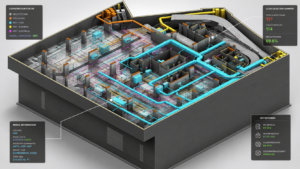
- Use BIM sequenced models (4D/5D) to optimize site logistics, minimize idle materials.
- Track waste metrics on-site
- Use BIM data plus site tracking (scanning, sensors, site reports) to monitor scrap, rework, and off-cuts.
- Provide feedback loops to design/engineering to adjust future work.
- Plan for deconstruction & circular flows
- At the early design stage, incorporate waste management, reuse, and modular design for disassembly.
- Use BIM data (or digital twin extension) to plan end-of-life scenarios and waste diversion.
- Collaborate with the waste/recycling supply chain early.
- Monitor, report, and continuously improve
- Collect data on actual waste, cost savings, and diverted materials.
- Benchmark against targets, feed back into BIM standards, and organizational learning.
- Assign a BIM-governance role to ensure continuity (avoid “tribal knowledge” loss) and embed waste-minimization in firm culture.
[/vc_column_text][vc_column_text css=””]
Real-World Examples & Emerging Trends
Here are a few recent case examples and trends that illustrate how advanced BIM implementation is evolving in the waste-reduction space:
- Projects using BIM and digital twin frameworks for demolition planning have generated strategies for maximising component reuse and reducing life-cycle carbon emissions.
- A review of the circular economy in construction highlights how BIM is central to enabling dynamic material flows, component reuse, and digital twin integration.
- In a Korean case study, BIM-based design validation prevented between 4.3% and 15.2% of otherwise-avoidable construction waste.
These examples underscore that BIM implementation is no longer optional for firms targeting sustainability and efficiency — it is becoming a strategic differentiator.
[/vc_column_text][vc_column_text css=””]
Why Firms Cannot Afford to Ignore BIM Implementation for Waste Reduction
- Cost savings & margin protection: Material waste is wasted profit. Every kilogram not used or misused hits the margin.
- Sustainability & regulatory alignment: As governments push for a circular economy and zero-waste construction, BIM implementation gives firms a credible response.
- Client/mining demands: Owners increasingly expect demonstrable waste reduction, circularity, and digitization — BIM implementation becomes a competitive advantage.
- Operational risk reduction: Rework, off-cuts, idle materials, and logistics inefficiencies all escalate risk. BIM implementation helps mitigate those.
- Future-proofing: With growth in digital twin, material-passport, sensor-enabled, lifecycle BIM workflows, organizations that embed BIM now will benefit long-term.
[/vc_column_text][vc_column_text css=””]
Key Takeaways for AEC Firms
- BIM implementation must be viewed as a strategic lever for waste reduction, not just a design tool.
- Early design coordination, accurate quantities, prefabrication, and logistics planning are high-impact areas.
- Lifecycle thinking (reuse, disassembly, circular economy) is increasingly integral to waste reduction, and BIM-enabled digital twins are the frontier.
- Implementation requires organizational change: standards, roles, training, governance, and procurement integration.
- Monitoring, feedback, and continuous improvement are essential — set measurable KPIs and track the actual waste savings.
- Waste reduction via BIM is quantifiable: 20-30% material savings, 60-70% formwork waste reduction, and major reductions in landfill diversion are not just aspirational.
- Firms that treat BIM implementation as part of the sustainability and efficiency strategy will gain cost, reputation, and compliance benefits.
[/vc_column_text][vc_column_text css=””]
At ReviCAD Solutions, we help AEC firms turn their BIM vision into measurable project outcomes — including reduced waste, optimized resource utilization, and improved profitability. Our BIM implementation services go beyond software adoption; we build tailored workflows that align with your design, engineering, and construction goals. From creating detailed BIM Execution Plans and conducting clash detection to integrating prefabrication models, material take-offs, and lifecycle data, our team ensures every stage of your project drives efficiency and sustainability. Whether you’re beginning your BIM journey or scaling enterprise-wide standards, ReviCAD brings the right mix of technical depth, industry experience, and process innovation to help you implement BIM for maximum impact and minimal waste.
[/vc_column_text][vc_column_text css=””]
References & Further Reading
- CMI Group Inc. — Construction Waste Strategies for Minimizing and Recycling Waste
- ABC SoCal — BIM in Reducing Construction Waste
- ResearchGate — Quantification of Construction Waste through BIM
- AZO Build — How BIM Is Reducing Construction Waste
- ScienceDirect — BIM-Based Digital Twin Framework for Demolition Waste Management
- Nature — BIM-Based Digital Twin Framework for Construction Waste Estimation
- ConstructConnect Canada — Reducing Construction Waste through BIM Prediction Modelling
- Springer — Challenges and Interoperability in BIM for Waste Reduction
- MDPI — Level of Development and Model Quality for Sustainable BIM
- University of Washington Digital Library — Waste Reduction through Prefabrication and BIM Integration
[/vc_column_text][/vc_column][/vc_row]


