Healthcare
Hospital Projects Don’t Fail in Design, They Fail in Coordination
Building safer healthcare facilities through better coordination
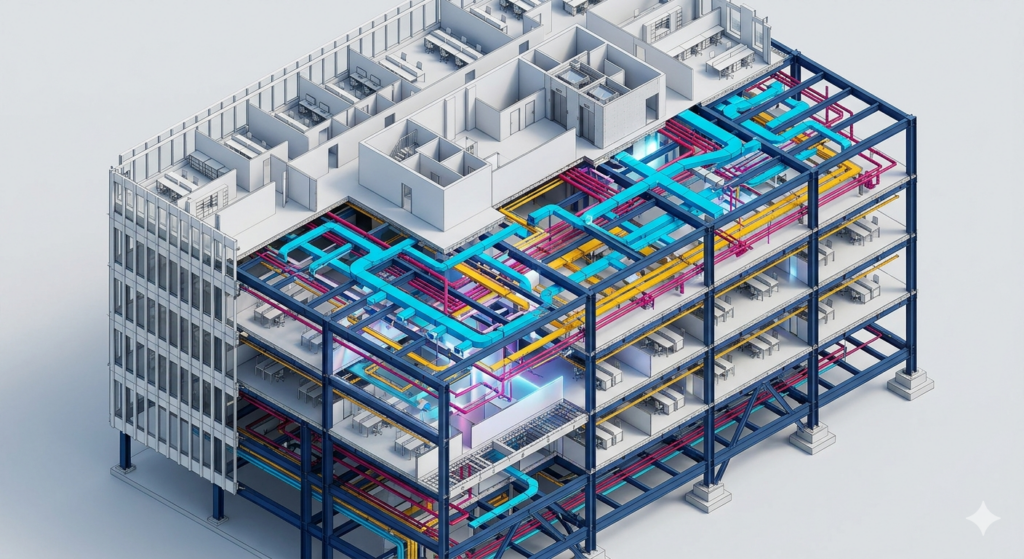
Healthcare projects like operation theatres, ICUs and medical gas systems need a very different level of coordination. These are not typical buildings, and even small mistakes can lead to bigger issues later, sometimes even affecting patient safety. There are constant challenges like tight ceiling spaces, late equipment changes, and critical zones where there is no room for error. This is usually where problems begin. Clashes, misalignment and on-site confusion are more common than they should be.
At ReviCAD, we work with contractors, hospital developers and MEP teams to resolve these issues before they reach site. We focus on early clash resolution, validating equipment layouts, and creating BIM models that can actually be used during construction, not just for drawings. We also support live hospital projects where phasing becomes important, helping teams achieve better buildability, fewer surprises and less rework in sensitive areas.

Core BIM services for infrastructure projects
Medical equipment planning & BIM integration
We validate layouts for MRI, ICU and OT equipment. Making sure clearances work properly and everything fits well with MEP and architectural systems.
High-density MEP coordination
We help detect and resolve clashes across HVAC, electrical, plumbing, fire and medical gas systems, especially in tight ceiling areas.
OT & ICU BIM modeling
We model them with proper coordination between equipment and services, including airflow and maintenance access which often gets overlooked.
Medical gas system modeling
We coordinate oxygen, vacuum and compressed air systems with correct routing and compliance in mind.
Shop Drawings & Installation Documentation
LOD 350 to 400 models, fabrication drawings and spool drawings to support smooth execution on-site.
Scan-to-bim for hospital renovation
We create accurate as-built models using point cloud data and help plan phased work without disrupting operations too much.
Revolutionizing Piping Design in Illinois – A Revit LOD 350 Story
In a healthcare project in Illinois, piping systems, especially medical gas and MEP networks, were becoming difficult to manage due to unclear coordination between teams and increasing clashes. ReviCAD developed detailed LOD 350 BIM models to improve routing and bring better alignment across systems, which resulted in fewer site conflicts, improved installation accuracy and smoother coordination overall through better planning and execution.
How we work
Requirement Understanding
Aligning with your project scope, standards and deliverables
Pilot / Sample
Demonstrating capability before full-scale engagement
Execution
Dedicated resources or project-based deliver
Quality Checks & Coordination
Ensuring accuracy and clash-free models
Delivery & Ongoing Support
Continuous collaboration until project completion
Flexible engagement model
Every project is different, and requirements often change as the work progresses. Instead of following a fixed approach, we stay flexible and adapt to what your team needs, whether it’s dedicated BIM resources, full project support, or additional help during peak workloads. Our goal is simple, to support your team effectively without adding extra pressure on your side.
Frequently asked questions
Why is BIM critical for hospital and healthcare projects?
Hospitals have dense systems and strict requirements. BIM helps catch clashes early, validate layouts and avoid delays in areas like OTs and ICUs.
How is healthcare BIM different from commercial BIM?
It involves tighter coordination. Equipment, MEP and compliance all need to work together. It is more about functionality than just visuals.
Can BIM reduce MEP clashes in hospital projects?
Yes. BIM helps identify and resolve clashes between different systems before construction starts.
How does BIM support OT and ICU planning?
We follow a structured QA process that includes regular model checks, clash detection, and validation against project requirements. The goal is to make sure the model is not just accurate, but also usable for coordination and execution.
Can BIM be used for hospital renovation projects?
It helps ensure proper equipment placement, required clearances and coordinated services.
What LOD is required for healthcare BIM projects?
Usually LOD 300 to 400, depending on the stage of the project.
What should contractors look for in a healthcare BIM partner?
Experience in hospital projects, strong MEP coordination skills, ability to handle changes and support during construction.
More to explore
Dinesh Desai
June 3, 2026
Dinesh Desai
April 24, 2026