Infrastructure
Build Infrastructure That Works in the Real World, Not Just on Drawings
Infrastructure doesn’t fail in design. It fails in coordination.
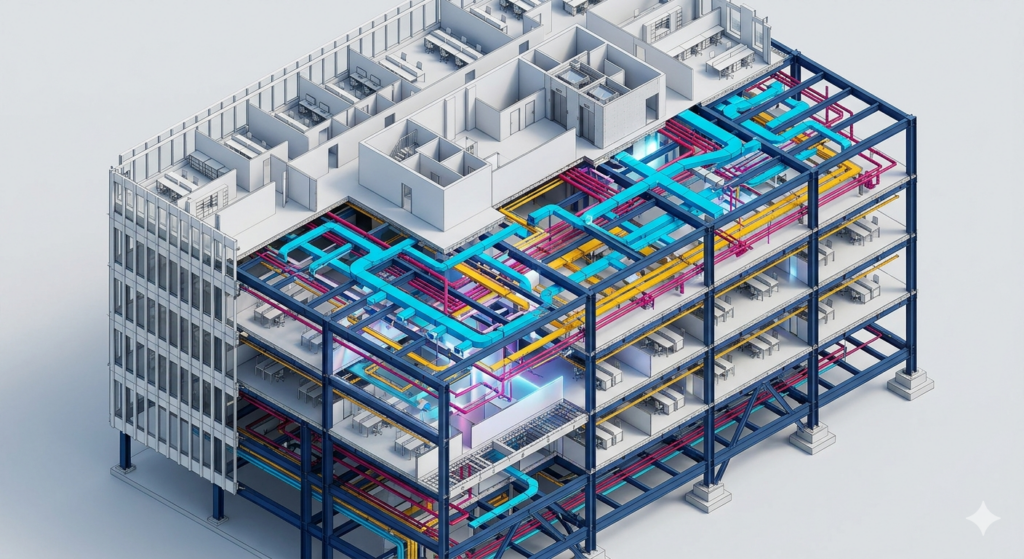
Infrastructure projects, from highways and rail corridors to bridges and utilities, don’t really fail because of design. They fail due to poor coordination across long stretches. ReviCAD helps teams model, coordinate, and validate what actually gets built by aligning terrain, utilities, structures, and construction phases into one clear, buildable view.
Unlike buildings, infrastructure projects are linear, multi-package and constantly evolving. That’s where issues start showing up. Not in design intent, but in disconnects between alignment, terrain, utilities and execution. We help bridge that gap by coordinating corridor-level models, identifying clashes early and supporting phased construction. Even a small mismatch at one chainage can create rework across kilometers.

Core BIM services for infrastructure projects
Corridor modeling & alignment coordination
Develop and coordinate road, highway and rail alignments with terrain to ensure accurate corridor-level models that can actually be built.
Utility & drainage coordination
Identify and resolve conflicts between underground utilities, drainage systems and structural elements before excavation begins.
Bridge & structural BIM modeling
Create detailed models for bridges, flyovers and viaducts that align properly with corridor design and execution needs.
4D Construction Sequencing & Phasing
Plan construction stages, including traffic diversions and temporary works, to support smoother execution in live environments.
Quantity takeoffs & cost support (5d BIM)
Generate quantities for earthworks, pavements and structures to support better estimation, BOQs and cost control.
Scan-to-BIM & reality capture
Convert survey and point cloud data into as-built models that reflect actual site conditions for retrofit or expansion work.
High-precision LOD 400 modeling for telecom towers (Italy)
For this telecom infrastructure project, ReviCAD developed detailed LOD 400 models to support coordination between structural components and installation requirements. The models focused on fabrication accuracy, so elements could be produced and assembled correctly on-site. This helped improve execution accuracy and reduced the need for adjustments during installation.
How we work
Requirement Understanding
Aligning with your project scope, standards and deliverables
Pilot / Sample
Demonstrating capability before full-scale engagement
Execution
Dedicated resources or project-based deliver
Quality Checks & Coordination
Ensuring accuracy and clash-free models
Delivery & Ongoing Support
Continuous collaboration until project completion
Flexible engagement models
Every project runs differently, and the level of support needed can change as things move forward. Instead of using a fixed approach, we adapt based on what works best for your team. This could be ongoing support through dedicated BIM resources, full execution for a defined scope, or additional help during peak workloads. The idea is simple. Give you flexibility to scale without adding pressure on your internal teams.
Frequently asked questions
How is BIM for infrastructure different from building BIM?
Infrastructure BIM works across long corridors, not single buildings. It focuses on alignment, terrain and utilities, where small changes can affect larger sections downstream.
Can BIM help detect underground utility conflicts before construction?
Yes. By combining utilities, drainage, terrain and structures in one model, BIM helps identify clashes early. This reduces surprises, rework and delays on-site.
How does BIM support highway and rail project execution?
BIM supports execution through corridor-level visualization, construction sequencing, accurate quantities and coordination across disciplines. This helps ensure designs can be built as planned.
Can BIM handle frequent design changes and survey updates?
Yes. BIM allows quick updates to models, quantities and drawings, helping teams stay aligned with changing inputs without major rework.
Do you work with GIS, survey, and point cloud data?
Yes, we integrate survey data, GIS layers and point clouds so models reflect real site conditions, not just design assumptions.
What level of detail (LOD) is required for infrastructure BIM?
It depends on the stage. Concept models may be LOD 100 to 200, while construction models go up to LOD 350 or 400. The focus is on usability, not just LOD labels.
Why should infrastructure contractors outsource BIM/CAD services?
Outsourcing helps scale teams faster, reduce costs and access specialized expertise, while maintaining faster turnaround with dedicated support.
More to explore
Dinesh Desai
June 3, 2026
Dinesh Desai
April 24, 2026