Skip to content

General Contractors & Construction

Build Without Guesswork. Coordinate Before You Pour.

Where construction projects actually break down (and how we fix it)

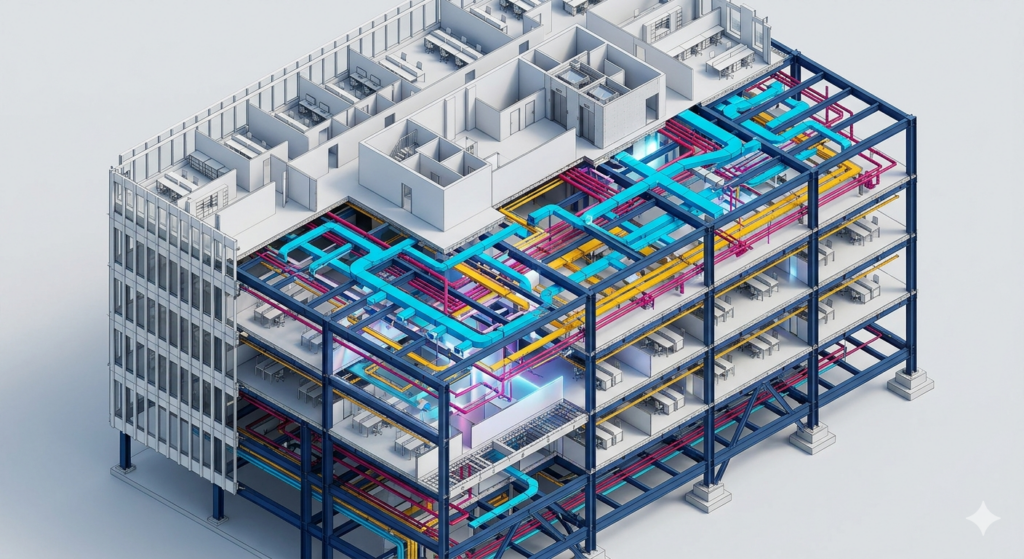
Most construction issues don’t really start on-site, they begin much earlier, hidden in drawings, coordination gaps, and unresolved design decisions. What looks coordinated on paper often starts to fall apart during execution, when ducts clash with beams, or multiple trades try to use the same space, or even when shop drawings don’t fully reflect actual site conditions. These gaps usually lead to RFIs, delays, and a lot of firefighting on-site.

At ReviCAD, we look at BIM not just as a deliverable, but more as a practical construction tool. We focus on identifying issues that actually impact execution, making sure what is modeled can be built, installed, and coordinated in real conditions. The goal is simple, help shift projects from reactive problem-solving to more proactive planning (before things go wrong).

Core services built for general contractors and construction companies

BIM coordination & clash detection

Identify and resolve MEP, structural, and architectural conflicts early, before they turn into site delays or RFIs.

Shop drawings & fabrication models

Deliver fabrication-ready, highly detailed models that help with smoother off-site production and faster installations.

4d construction sequencing (time planning)

Visualize timelines and plan construction activities better, especially useful in tight, phased or even live environments.

5d quantity takeoff & cost support

Improve estimation accuracy and get better control over budgets, bidding and cost forecasting.

Scan-to-BIM for renovation & Retrofit

Capture real-world site conditions with good accuracy, reducing uncertainties and chances of rework in existing structures.

Construction documentation & cad drafting

Produce clear, coordinated and updated drawings that keep teams aligned, even as designs keep evolving.

Case study: BIM in action

Revolutionizing Piping Design in Illinois – A Revit LOD 350 Story

In this project, a complex piping system required detailed coordination across multiple trades. ReviCAD developed a coordinated LOD 350 model that helped reduce clashes between piping and structural elements. This resulted in smoother installation and reduced the need for on-site adjustments, helping the contractor stay on schedule and maintain quality standards as well.

How we work

Requirement Understanding

Aligning with your project scope, standards and deliverables

Pilot / Sample

Demonstrating capability before full-scale engagement

Execution

Dedicated resources or project-based deliver

Quality Checks & Coordination

Ensuring accuracy and clash-free models

Delivery & Ongoing Support

Continuous collaboration until project completion

Flexible Engagement Model

Every project runs differently, and the level of support needed can change as things move forward. Instead of forcing a fixed approach, we adapt to what works best for your team. Whether you need ongoing support through dedicated BIM resources, full execution for a defined scope, or just extra help during peak workloads. The idea is pretty straightforward: give you flexibility to scale, without adding extra pressure on your internal teams.

Frequently asked questions

How does BIM help reduce rework on construction projects?

BIM helps identify and resolve clashes between trades before construction begins. By coordinating MEP, structural, and architectural systems early, it prevents on-site conflicts that usually leads to rework, delays, and extra costs.

Design models focus more on intent, not execution. Construction BIM takes this further by adding coordination, sequencing, and installation logic, so everything can actually be built on-site.

Yes, most construction projects rarely have perfect inputs. We work with whatever is available—drawings, markups, updates and keep adapting models as designs evolve.

We typically work at LOD 300 to LOD 400, depending on what is required. The focus is on delivering the right level of detail needed for coordination and execution, not over-modeling unnecessarily.

With 4D BIM, we connect models with schedules to visualize sequencing and identify conflicts early on. This helps avoid trade overlaps and improves planning overall.

We model with construction in mind, considering access, installation sequences, and real-world constraints. This ensures the model reflects how work actually happens on-site, not just how it looks in design.

More to explore

Ready to build smarter with BIM?

Let’s discuss how ReviCAD can keep your projects on track.