





- Part of: The ReviCAD Handbook: Business Value of BIM (2026 Edition)
- Estimated Reading Time: 12–15 minutes
Executive Summary
Building Information Modeling did not replace CAD simply because it created better 3D models. It transformed the construction industry because it fundamentally changed how project information is created, managed, shared, and used to make decisions. The evolution from drafting to digital intelligence represents an integrated Common Data Environment (CDE) where geometry connects with parametric metadata (4D Time, 5D Cost, 6D Sustainability, 7D Operations) under international standards like ISO 19650.
At a Glance: What You’ll Discover in This Chapter
- Why CAD solved drafting speed but failed to solve information fragmentation.
- How BIM evolved from a design tool into an enterprise information management platform.
- The five evolutions and dimensions of BIM maturity (from 2D drafting to 7D lifecycle facility operations).
- Why project information has become essential, invisible infrastructure.
- How Digital Twins, COBie data standards, and Predictive AI represent the next evolution of BIM.
The Evolution Was Never About Better Drawings
Every major technological shift in construction has been driven by a common objective: helping project teams make better decisions.
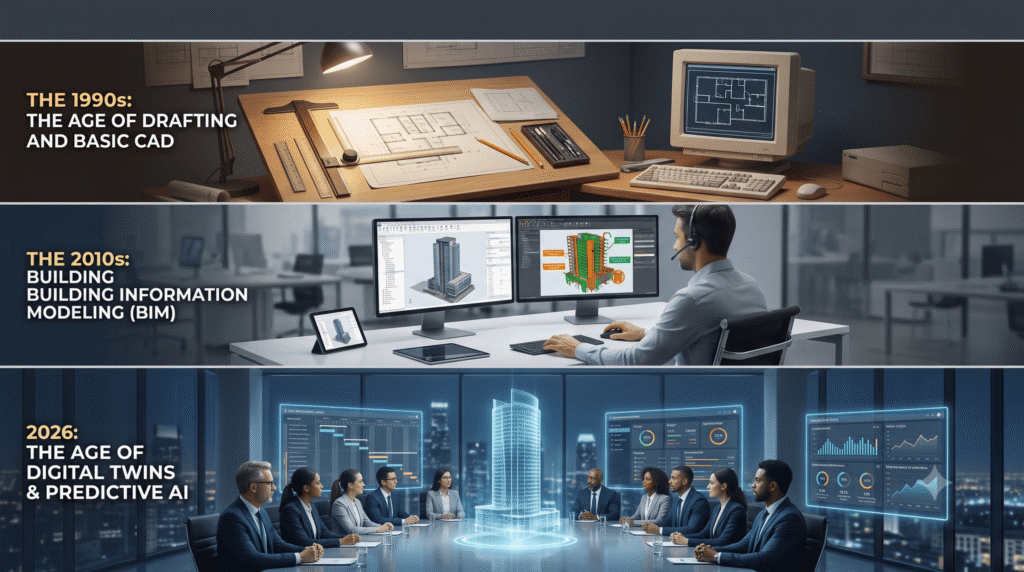
Hand drafting helped engineers communicate ideas on paper. Computer-Aided Design (CAD) dramatically improved the speed and accuracy of producing those drawings. Building Information Modeling went a step further by embedding parametric intelligence within digital models, making coordination more efficient and reducing many of the errors that traditionally surfaced during construction.
Yet, looking back, it’s clear that the industry’s evolution was never simply about producing better drawings. It was about improving the quality, accessibility, and reliability of project information.
That’s an important distinction because it explains why BIM continues to evolve while CAD, despite remaining an essential design tool, no longer addresses the full complexity of modern construction.
Today’s projects generate far more information than drawings alone can communicate. Owners expect data-rich assets that support facilities management and asset management platforms. Contractors require coordinated information to improve construction sequencing and reduce rework. Manufacturers increasingly provide digital product data (such as parametric Revit families), while project teams rely on cloud-based collaboration platforms to coordinate hundreds of stakeholders across multiple locations.
The industry’s challenge is no longer documenting buildings. It is managing information that supports better decisions throughout the entire lifecycle of those buildings.
A Brief History of Digital Construction
The evolution from drafting boards to intelligent digital assets did not happen overnight. It reflects decades of continuous improvement in how construction information is created, shared, and managed.
| Era | Primary Output | Industry Challenge | Business Limitation | Strategic Value / Standard |
|---|---|---|---|---|
| Manual Drafting | Paper drawings | Slow production | Difficult revisions & physical delays | Foundational design intent |
| CAD | Digital drawings (DWG/DXF) | Faster drafting | Information remained disconnected | Drafting speed & geometric accuracy |
| 3D Modeling | Visual surface/solid models | Better visualization | Limited intelligence & poor collaboration | Early spatial awareness & marketing |
| BIM | Parametric 3D/4D/5D models | Coordinated delivery | Organizational adoption & governance | ISO 19650 CDE & Clash Resolution |
| Connected BIM & Digital Twins | Connected asset intelligence | Lifecycle optimization | Data interoperability (IFC/COBie) & AI maturity | Predictive maintenance & Enterprise BI |
The evolution from drafting boards to intelligent digital assets did not happen overnight. It reflects decades of continuous improvement in how construction information is created, shared, and managed.
CAD Changed Drafting. BIM Changed Delivery.
Computer-Aided Design transformed the way drawings were produced. Revisions that once required hours of manual effort could be completed in minutes. Standard details became reusable digital blocks. Accuracy improved dramatically.
However, CAD still treated every drawing as an independent document.
If an architect moved a wall, multiple structural and MEP drawings often required manual updates. Coordination between architectural, structural, and MEP disciplines still depended heavily on human communication. The drawings became digital, but the workflow remained fragmented.
BIM introduced a fundamentally different way of working. Rather than creating disconnected drawings, project teams began developing a shared digital representation of a building where geometry and information remained connected. A design change in one area could automatically update schedules, quantities, views, and related documentation, reducing inconsistencies and improving confidence in project information.
The real innovation wasn’t drafting automation. It was information consistency.
Executive Insight: CAD helped teams produce drawings faster. BIM helps organizations trust that information enough to make better business decisions.
The Five Evolutions & Dimensions of BIM
One of the biggest misconceptions about BIM is that it represents a single technology. In reality, BIM has matured through several distinct stages and dimensions, each expanding its contribution to project delivery and business performance.
| Evolution / BIM Dimension | Primary Focus | Technical Implementation | Business Outcome |
|---|---|---|---|
| 1. Digital Drafting (2D) | Replace manual drawings | 2D CAD vector files | Faster documentation |
| 2. Model Coordination (3D) | Spatial visualization & reduce clashes | Parametric 3D geometry | Reduced site conflicts & rework |
| 3. Information Management (4D/5D) | Centralize schedule & cost data | 4D Time sequencing & 5D Cost planning | Better budget/schedule predictability |
| 4. Business Integration (6D) | Sustainability & performance modeling | Carbon tracking & energy analysis | Higher project predictability & ESG alignment |
| 5. Digital Intelligence (7D Twin) | AI, Digital Twins, lifecycle analytics | COBie data handovers & IoT sensors | Continuous asset & OPEX optimization |
Organizations often believe they have ‘implemented BIM’ simply because they produce 3D models. In practice, the greatest business value emerges only when BIM evolves into 4D–7D dimensions, becoming fully integrated into organizational processes, information governance (ISO 19650), and lifecycle decision-making.
Information Has Become Infrastructure
Construction materials have always been tangible. Concrete, steel, timber, glass, and mechanical systems define the physical structure of a building.
Increasingly, however, another asset has become just as valuable—project information.
Reliable information influences procurement, scheduling, coordination, quality assurance, compliance, commissioning, operations, maintenance, renovations, and even eventual demolition. Unlike physical materials, information continues to generate value long after construction has been completed.
In many respects, information has become invisible infrastructure. It supports every decision made throughout the lifecycle of a built asset.
Organizations that recognize this shift are no longer investing in BIM simply to improve design coordination. They are investing in information architectures that support better business outcomes for decades.
From the ReviCAD Desk: One pattern we’ve consistently observed across BIM projects is that clients rarely struggle with modeling software. The more persistent challenge is maintaining consistent, reliable information as projects move from concept design through detailed engineering, procurement, construction, and facilities management. Projects become significantly easier to manage when every stakeholder works from the same trusted Common Data Environment (CDE) rather than multiple disconnected versions of the truth.
Why This Evolution Matters
The transition from CAD to BIM represents much more than a technological upgrade. It reflects a broader shift in how organizations think about value creation.
Competitive advantage is no longer determined solely by design capability or drafting speed. Increasingly, it depends on how effectively organizations capture, manage, govern, and reuse information across the building lifecycle.
This shift is particularly important as artificial intelligence, digital twins, cloud collaboration environments, and predictive analytics become more deeply integrated into construction workflows. None of these technologies can deliver meaningful value without structured, reliable information (such as ISO 19650-compliant models) as their foundation.
BIM provides that foundation.
Looking Ahead: AI and the Next Era of BIM
The next stage of BIM’s evolution is already underway.
Artificial intelligence is beginning to automate model validation, identify coordination risks before clash detection, and support generative design optimization. Digital Twins are extending the usefulness of BIM far beyond construction, enabling owners to monitor performance, predict maintenance requirements, and make operational decisions using live asset data.
These developments reinforce a simple but powerful idea: BIM has evolved from a design methodology into the digital backbone of modern construction.
The organizations that understand this evolution will be better positioned to adapt to the next wave of innovation.
Key Takeaways
- CAD improved the efficiency of producing drawings, while BIM transformed the way project information is managed across a Common Data Environment (CDE).
- The evolution of BIM reflects a structural shift from manual documentation to data-driven decision-making.
- Structured project information has become one of the construction industry’s most valuable long-term business assets.
- The greatest value of BIM is realized when it supports the full lifecycle of a built asset (7D BIM / COBie handovers) rather than only the design phase.
- AI, Digital Twins, and ISO 19650 connected data platforms represent the next stage in BIM’s evolution, making reliable information more important than ever.
