








- Part of: The ReviCAD Handbook: Business Value of BIM (2026 Edition)
- Estimated Reading Time: 12–15 minutes
Executive Summary
BIM initiatives rarely fail due to software limitations or rendering engine flaws. Failure occurs when BIM is treated as an isolated drafting activity rather than an enterprise information governance program. Common pitfalls include buying technology before defining the business problem, substituting geometric Level of Development (LOD) for structured information requirements, mistaking automated clash detection for proactive coordination, siloing data inside specialist BIM teams, and abandoning model governance at project handover. Sustainable ROI requires designing information backward from the critical operational decisions it must inform.
At a Glance: What You’ll Discover in This Chapter
- What “BIM failure” looks like in real commercial projects (and why it is rarely a technical crash).
- The 9 most prevalent mistakes that turn high-investment BIM models into low-yield overhead.
- The critical conceptual distinction between geometric LOD and buildingSMART’s machine-readable Information Delivery Specification (IDS).
- Why automated clash detection reports are not equivalent to true spatial-temporal coordination.
- The ReviCAD 6-Question Failure-Proofing Framework and the 10-point executive BIM Health Check.
- How to transition from a project-centric modeling deliverable to an enduring corporate information advantage.
What Does It Actually Mean for BIM to “Fail”?
BIM failure is seldom catastrophic or sudden. Projects do not typically abandon Revit or shut down their Common Data Environment (CDE) in dramatic fashion.
Instead, BIM fails by underperforming:
- The Shelf-Ware Model: A comprehensive model is delivered, but site superintendents and project managers continue working from printed 2D drawings and static PDFs.
- The Coordination Mirage: Automated clash detection generates hundreds of pages of unclassified conflicts, while true spatial-temporal clashes are discovered on-site during installation.
- The Construction Rebuild: The general contractor or MEP subcontractor receives a design-intent model that lacks constructability, forcing them to rebuild the geometry from scratch for fabrication.
- The Handover Void: The owner receives an “as-built BIM model,” but the asset metadata is incomplete, unstructured, or incompatible with their enterprise CMMS/IWMS platforms.
- The Specialist Bottleneck: The BIM team becomes an administrative bottleneck because non-modeling stakeholders cannot access model data directly.
Rather than asking “Did we implement BIM?”, leadership must ask: “Did our BIM implementation measurably improve decision speed, reduce rework, and protect our commercial margin?”
The 9 Most Common BIM Implementation Mistakes
| # | The Strategic Mistake | Real-World Consequence | The Mature Alternative |
|---|---|---|---|
| 1 | Technology-First Procurement | Purchasing software without a defined business purpose. | Define the commercial pain point, then select tools around the use case. |
| 2 | The 3D Modeling Trap | Valuing visual geometry over underlying asset data. | Treat the model as a data container governed by ISO 19650 standards. |
| 3 | Compressed Coordination | Postponing trade coordination until right before site mobilization. | Execute phase-aligned coordination tied to design maturity milestones. |
| 4 | Arbitrary LOD Specifications | Requesting blanket "LOD 350/400" without defining data needs. | Specify machine-readable requirements via buildingSMART IDS / LOIN. |
| 5 | Clash Detection ≠ Coordination | Generating raw clash reports without multidisciplinary resolution. | Implement a structured Detect → Classify → Prioritize → Resolve process. |
| 6 | Proprietary Ecosystem Lock-in | Creating models that cannot transfer across multi-vendor software. | Mandate OpenBIM (IFC, BCF, openCDE APIs) to secure cross-platform data. |
| 7 | The BIM Department Silo | Isolating model data inside an insular modeling department. | Democratize data access across commercial, site, and executive teams. |
| 8 | Neglecting Change Management | Budgeting for software licenses while ignoring workforce upskilling. | Train teams on information workflows, decision ownership, and QA review. |
| 9 | The Handover Abandonment | Halting information governance the moment construction finishes. | Maintain asset metadata continuously under ISO 19650-3 operational protocols. |
Detailed Breakdown: Anatomy of Implementation Failures
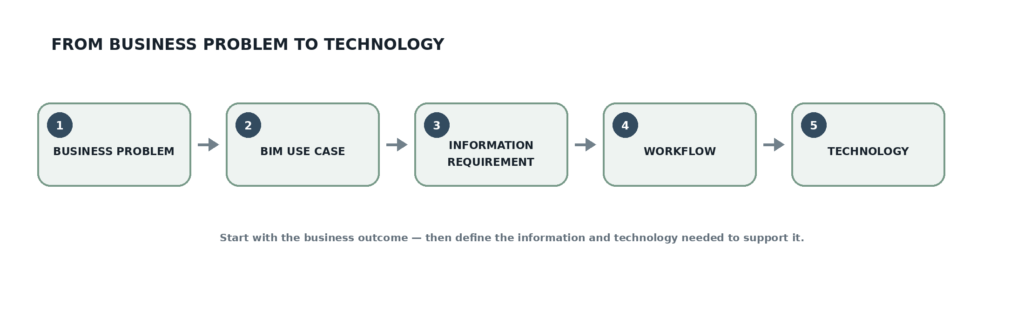
1. Starting with Software Instead of the Business Problem
The most common mistake is buying software first and seeking purpose second. Firms invest heavily in licenses, point-cloud tools, and cloud platforms, then task their technical staff with finding applications for them.
Mature implementations reverse this workflow:
2. Treating BIM as a 3D Modeling Exercise
A model can be geometrically immaculate while remaining functionally useless. A 3D parametric wall element may appear visually correct, but if it lacks structural classification, acoustic ratings, fire certifications, material IDs, and cost parameters, it cannot support downstream estimation, procurement, or operational maintenance.
Executive Insight : The 3D model is merely the vehicle; the structured, queryable information inside it is the asset.
3. Starting Coordination Too Late
Coordination is frequently scheduled immediately prior to construction mobilization, forcing teams to resolve major multi-trade clashes under severe time constraints. Conversely, coordinating too early—before the design reaches baseline maturity—results in wasted rework whenever major architectural revisions occur. Coordination must be integrated incrementally at explicit design milestones.
4. Defining LOD Without Defining the Information Need
Requesting blanket “LOD 300” or “LOD 400” models across an entire facility leads to over-modeling in non-critical zones and under-modeling where data is vital. Modern delivery relies on Level of Information Need (LOIN) and machine-readable frameworks like buildingSMART’s Information Delivery Specification (IDS), which define explicit geometric and alphanumeric properties for each system.
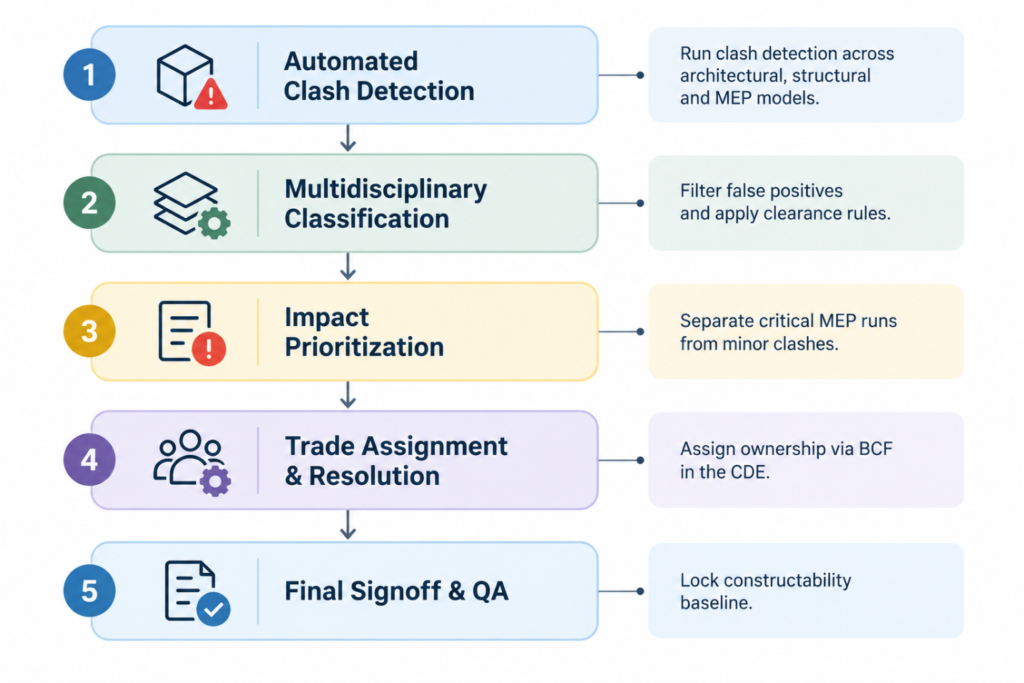
5. Assuming Clash Detection Equals Coordination
Automated clash detection indicates that two volumes occupy shared spatial coordinates. It cannot determine design intent, construction sequencing, or site tolerances. Software simply identifies that two physical volumes intersect. It cannot assess design intent, trade sequencing, structural allowances, or maintenance accessibility.
A high-performing coordination workflow does not stop at exporting a clash report; it follows a disciplined decision pipeline:
6. Creating Models That Cannot Travel with the Project
A facility is designed, constructed, and operated by dozens of independent organizations across its lifecycle. When models are authored exclusively within proprietary formats without export validation, information degrades each time it crosses organizational boundaries.
Mandating OpenBIM standards—such as IFC (Industry Foundation Classes), BCF (BIM Collaboration Format), and open CDE APIs—ensures that data authored during design remains readable and actionable for contractors and asset managers, regardless of software choice.
7. Isolating BIM Inside a Departmental Silo
When BIM is treated exclusively as an internal production tool for a dedicated modeling department, an organizational bottleneck is created. Site superintendents, commercial estimators, and project managers must submit formal information requests to the BIM team just to extract quantities or verify spatial relationships.
A mature implementation democratizes model intelligence across the business. Through web-based Common Data Environments (CDE) and user-friendly viewer interfaces, every project stakeholder can directly query the spatial and parameter information relevant to their day-to-day decisions.
8. Underestimating People, Skills, and Change Management
Procuring enterprise software licenses takes days; transforming how multi-disciplinary teams communicate, record, and validate information takes months. Organizations frequently exhaust their budgets on software subscriptions, leaving zero investment for comprehensive workforce upskilling.
True BIM training goes far beyond software keystrokes:
- Understanding why information parameters are mandatory downstream.
- Knowing how data transfers between design, procurement, and facility platforms.
- Enforcing quality gates and accountability before releasing model revisions.
9. Delivering the Model and Forgetting the Asset
Treating project handover as the end of information management undermines the long-term return on investment. Once construction concludes, models are routinely shelved, warranties are archived in unindexed PDFs, and the digital representation stops reflecting real-world alterations.
Under ISO 19650-3, information governance continues throughout the operational phase. Assigning operational data custodians ensures asset metadata remains current, establishing the clean baseline required for computerized maintenance (CMMS) and Digital Twin platforms.
The BIM Failure Chain Reaction
When basic information governance is omitted early in the project, the downstream consequences compound exponentially across the construction timeline:
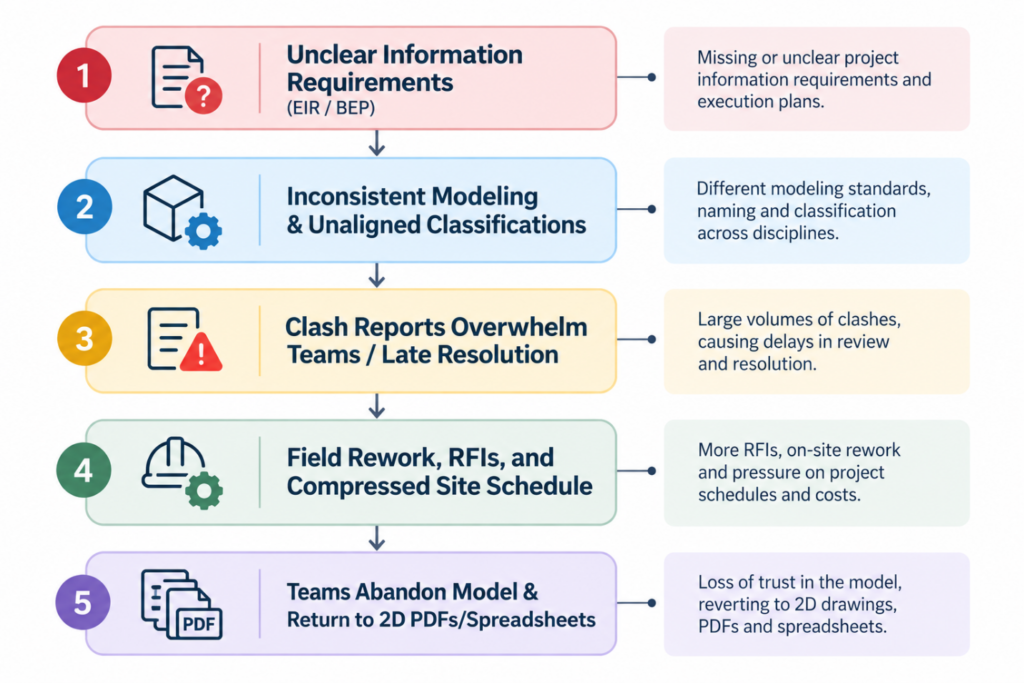
The resulting failure is not caused by technical limitations; it is the predictable outcome of an ungoverned information workflow.
The ReviCAD 6-Question Failure-Proofing Framework
Before initiating a major BIM project, project leadership should establish governance by answering six fundamental questions:
| Question | Core Governance Objective | Primary Risk if Ignored |
|---|---|---|
| 1. WHY? | Identify the explicit business outcome or efficiency target. | Models created without measurable purpose or ROI. |
| 2. WHAT? | Define the exact geometric and alphanumeric data required. | Inconsistent data schemas and arbitrary over-modeling. |
| 3. WHO? | Assign explicit responsibility for data authoring and approval. | Gaps in scope, unowned clashes, and coordination friction. |
| 4. WHEN? | Align information drops with critical commercial decision gates. | Coordination performed too late to influence construction. |
| 5. HOW? | Standardize platforms, CDE protocols, and open standards (IFC). | Fragmented information silos and file translation errors. |
| 6. HOW DO WE KNOW? | Execute automated validation checks (e.g., IDS rules) and QA audits. | Undetected metadata errors propagate into the field. |
The Executive BIM Health Check
Use this 10-point audit checklist to evaluate project readiness before site mobilization:
| Health Check Diagnostic Question | Risk Exposure if Answer is "No" |
|---|---|
| 1. Is there an approved BIM Execution Plan (BEP) tied to clear business goals? | Modeling proceeds without defined objectives or contractual boundaries. |
| 2. Are information requirements documented via machine-readable specifications (IDS)? | Multi-discipline teams model parameters inconsistently across the CDE. |
| 3. Are discipline-specific coordination responsibilities contractually assigned? | Critical clashes remain unresolved due to unclear trade ownership. |
| 4. Does the project schedule allocate dedicated windows for constructability review? | Multi-trade coordination collapses into last-minute site firefighting. |
| 5. Are shared modeling standards, units, and shared coordinates verified? | Federated models fail to align accurately in spatial coordinates. |
| 6. Is a controlled, ISO 19650-compliant Common Data Environment (CDE) enforced? | Outdated drawing versions circulate across trade contractors on-site. |
| 7. Can all federated models export cleanly to open standards (IFC, BCF)? | Information is locked within proprietary ecosystems and cannot travel. |
| 8. Are automated model and metadata audits performed before each milestone release? | Corrupt parameters, missing specs, and geometric bugs reach production. |
| 9. Can non-modeling project leaders query model information without specialist support? | The BIM team becomes an operational bottleneck for daily decision-making. |
| 10. Is there a clear protocol for updating model parameters during physical handover? | The deliverable becomes obsolete the moment operations begin. |
From the ReviCAD Desk: At ReviCAD, our work across multi-discipline BIM modeling, Scan-to-BIM, CAD-to-BIM conversion, and parametric Revit family development is guided by one core standard: We design information backward from the decision. Whether modeling 45,000 sq. ft. of complex existing commercial structures in the UK or delivering MEP coordination models, geometric elements have value only when they support a tangible downstream process. High-performing BIM is not about producing more geometry; it is about providing verified, reliable information that reduces commercial uncertainty.
Frequently Asked Questions
What is the single most common BIM implementation mistake?
Procuring technology before defining the specific business problem. Organizations frequently purchase software licenses, cloud platforms, or hardware without identifying the operational bottlenecks (e.g., MEP coordination delays, excessive RFIs, or inaccurate handover records) the tools are intended to resolve.
Why do BIM projects run into trouble even when the 3D models look visually complete?
Because visual geometry and information integrity are completely different assets. A model can look immaculate in a 3D rendering while lacking the parameter metadata, classification codes, and spatial tolerances required for cost estimation, prefabrication, or facilities management.
Is specifying a high Level of Development (LOD) sufficient to prevent BIM failure?
No. LOD primarily communicates geometric completeness. It does not adequately define alphanumeric property requirements, classification standards, or operational maintenance parameters. Utilizing buildingSMART’s Information Delivery Specification (IDS) provides a machine-readable, verifiable methodology for defining exact data needs.
Does Building Information Modeling eliminate all on-site construction errors?
No. BIM eliminates digital clashes and improves sequencing predictability, but it cannot resolve unexpected site variances, late design modifications, or trade installation errors unless supported by continuous quality assurance and field verification (such as 3D laser scanning).
The End of the First Series: From Tools to Transformation
- Chapter 1: Why BIM Became a Business Strategy
- Chapter 2: From Drawings to Decisions: How Information Governs Projects
- Chapter 3: The Five Dimensions of BIM Business Value
- Chapter 4: Measuring the Real ROI of BIM
- Chapter 5: From Software to Strategy: Organizational Transformation
- Chapter 6: Beyond Handover: Asset Management & Operational Value
- Chapter 7: BIM Meets AI: Intelligent Construction in 2026
- Chapter 8: Digital Twins: Living Asset Intelligence Systems
- Chapter 9: Why BIM Projects Fail: The 9 Mistakes That Destroy Business Value
Key Takeaways
- Process Over Software: BIM implementations rarely fail due to technical limitations; they underperform due to undefined requirements, siloed workflows, and lack of accountability.
- Begin with Outcomes: High-performing BIM initiatives are designed backward from critical project and operational decisions.
- Coordination Requires Judgement: Automated clash detection is merely an analytical filter; multidisciplinary coordination requires active human decision-making and constructability review.
- Interoperability Protects Capital: Open standards (IFC, BCF, IDS) prevent vendor lock-in and ensure asset data remains usable across the full lifecycle.
- Continuous Information Governance: Project handover is not the finish line. Preserving structured asset data through ISO 19650-3 protects capital value long after construction concludes.
Sources and Research Notes
- ISO 19650 Series (Parts 1, 2, 3, and 5): International standards for organization and digitization of information about buildings and civil engineering works.
- buildingSMART International: Technical guidelines on openBIM, Information Delivery Specification (IDS), and Industry Foundation Classes (IFC4/IFC5).
- Autodesk Operational Insights (2026): Industry benchmarks on BIM data specialization, Common Data Environment workflows, and digital handoff protocols.
- RICS Professional Standards: Management of Information in Construction and Global BIM Guidance.
- ReviCAD Delivery Benchmarks: Applied protocols in multi-trade coordination, Scan-to-BIM verification, and enterprise parametric family governance.
