






- Part of: The ReviCAD Handbook: Business Value of BIM (2026 Edition)
- Estimated Reading Time: 12–15 minutes
Executive Summary
The return on investment (ROI) of Building Information Modeling extends well beyond reducing construction costs. While lower rework, fewer clashes, and improved productivity remain important financial outcomes, organizations increasingly evaluate BIM by its ability to improve project predictability, strengthen collaboration, reduce business risk, support lifecycle asset management (ISO 19650 CDE & COBie handovers), and create long-term competitive advantage. Measuring BIM ROI therefore requires a broader framework than traditional cost-benefit analysis.
At a Glance: What You’ll Discover in This Chapter
- Why traditional ROI calculations underestimate BIM’s true business value.
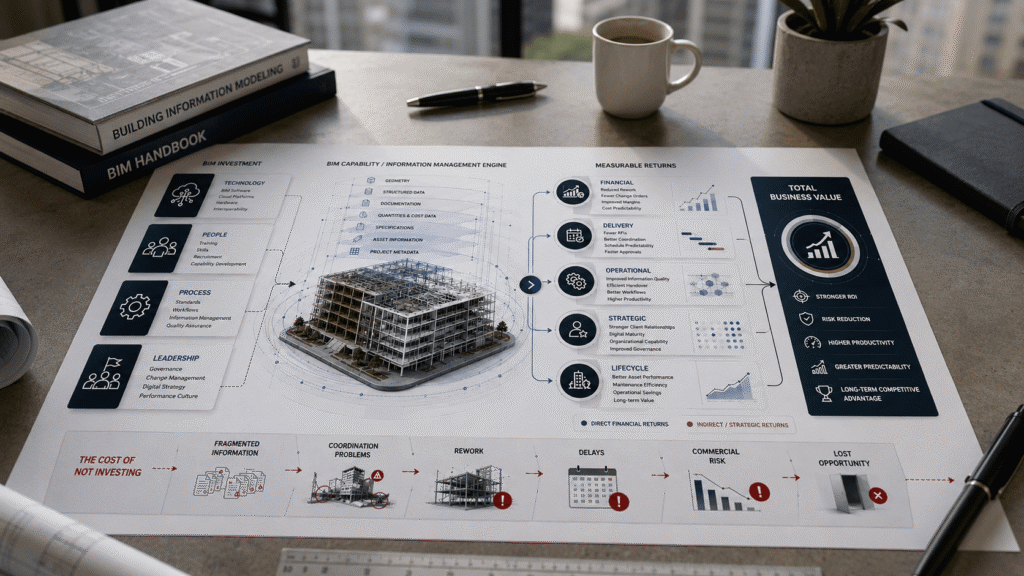
- The four categories of BIM investment (Technology, People, Process, Leadership).
- The hidden costs and financial liability of not implementing BIM.
- A practical 5-dimension framework for measuring multi-stakeholder BIM ROI.
- The key performance metrics that matter most to owners, contractors, consultants, and executive leadership.
ROI Is One of the Most Misunderstood Topics in BIM
One of the first questions organizations ask when considering BIM is straightforward: ‘What return will we receive on our investment?’ It is a reasonable question, particularly when implementation involves software, training, process changes, and organizational commitment.
The challenge is that Building Information Modeling does not behave like a conventional capital investment. Purchasing a new machine or upgrading office equipment often produces a direct and measurable financial return. BIM, by contrast, influences almost every stage of project delivery and continues creating value long after construction has been completed. Its benefits accumulate through improved coordination, better decision-making, reduced uncertainty, stronger collaboration, and more reliable project information.
As a result, organizations that evaluate BIM solely through immediate cost savings often overlook many of its most significant business benefits.
Why Traditional ROI Calculations Fall Short
Return on investment is typically expressed as the financial gain generated relative to the cost of an investment. While this approach works well for many business decisions, it provides only a partial picture when applied to BIM.
Many of BIM’s benefits are indirect. Avoiding a coordination issue before construction begins does not appear as additional revenue on a financial statement, yet it may prevent weeks of delay, costly rework, contractual disputes, and reputational damage. Similarly, delivering structured asset information (via ISO 19650 Common Data Environments) at project handover may not generate immediate financial returns, but it can reduce operational expenditure (OpEx) for decades.
This is why BIM should be evaluated as an enterprise business capability rather than a software purchase. The value it creates extends across financial performance, operational efficiency, organizational resilience, and lifecycle asset management.
The Real Cost of Not Using BIM
One aspect of the business case is often overlooked: the cost of maintaining traditional ways of working.
Organizations frequently compare the investment required to implement BIM with the cost of purchasing software, training staff, or adapting workflows. Far less attention is given to the cumulative impact of fragmented information, repeated coordination issues, duplicated effort, and avoidable design changes.
These costs are rarely presented as a single line item, yet they influence almost every project. When viewed over multiple projects and several years, the financial consequences of inefficient information management can exceed the initial investment required to establish mature BIM processes.
The business question therefore changes from ‘Can we afford to invest in BIM?’ to ‘Can we afford not to?’
The Four Categories of BIM Investment
One reason ROI discussions become confusing is that organizations tend to focus only on software costs. In reality, successful BIM implementation requires investment across several interdependent areas:
| Investment Area | Typical Components | Long-Term Value Enabled | Primary Business Impact |
|---|---|---|---|
| Technology | Software, hardware, cloud CDE platforms | Improved productivity & collaboration | Elimination of IT bottlenecks & legacy silos |
| People | Training, recruitment, capability development | Higher competency & technical consistency | Faster adoption & reduced employee friction |
| Process | ISO 19650 standards, templates, QA, governance | Repeatable delivery & reduced operational risk | Consistent project outcomes & standardized workflows |
| Leadership | Executive governance, change management, digital strategy | Sustainable organizational transformation | Long-term competitive advantage & digital maturity |
Organizations that invest only in technology often struggle to realize the full benefits of BIM because people and processes remain unchanged.
A Broader Framework for Measuring BIM ROI
Rather than asking a single financial question, organizations should evaluate BIM across several dimensions of performance:
| Dimension | Example Measures | Primary ROI Metric Signal |
|---|---|---|
| Financial | Reduced rework, improved margin, lower change orders | CapEx savings & contingency draw reduction |
| Delivery | Schedule predictability, coordination efficiency, RFI reduction | RFI volume reduction & milestone adherence |
| Operational | Better information quality, improved handover, asset readiness | Common Data Environment (CDE) velocity & BOQ accuracy |
| Strategic | Client retention, digital maturity, organizational capability | RFP win-rate on digital delivery bids |
| Lifecycle | Lower operating costs, maintenance efficiency, asset performance | COBie data accuracy & OpEx reduction via Digital Twins |
This broader perspective reflects the reality that BIM creates value at different times for different stakeholders. Some benefits are visible during design and construction, while others emerge years after project completion.
Executive Insight : The most valuable returns from BIM are often the ones that never appear on a traditional balance sheet.
From the ReviCAD Desk : Across many of the projects we’ve supported, discussions about ROI have evolved noticeably. Earlier conversations were dominated by software costs and implementation timelines. Today, clients are increasingly interested in delivery certainty, information quality, lifecycle asset value, and the ability to scale digital delivery across multiple projects. That change reflects a broader shift in industry thinking. BIM is no longer evaluated solely by what it costs to implement, but by the long-term value it enables throughout the lifecycle of a built asset.
Looking Ahead
Understanding ROI naturally leads to another important question: what does successful BIM implementation actually look like in practice?
In the next chapter, we’ll examine the common barriers to BIM adoption, the mistakes organizations make during implementation, and a practical roadmap for building mature BIM capability.
Key Takeaways
- Traditional ROI calculations underestimate BIM’s value by focusing solely on software costs and immediate CapEx savings.
- The real return on BIM includes indirect benefits like risk reduction, delivery predictability, and long-term OpEx reduction.
- Successful BIM investment requires a balanced allocation across Technology, People, Process, and Leadership.
- Maintaining traditional, fragmented workflows introduces hidden financial liabilities that often exceed initial BIM implementation costs.
- Leading organizations evaluate BIM ROI across multi-dimensional performance metrics throughout the built asset lifecycle.
