





- Part of: The ReviCAD Handbook: Business Value of BIM (2026 Edition)
- Estimated Reading Time: 12–15 minutes
Executive Summary
A BIM model is not automatically a digital twin. While BIM organizes structured static information about an asset’s geometry and physical properties, a digital twin establishes a dynamic, two-way connection between that digital representation and its real-world counterpart. By integrating BIM with IoT sensors, Building Management Systems (BMS), maintenance histories, and AI analytics, digital twins allow facility executives and operators to transition from reactive repairs to predictive maintenance, optimize energy consumption, and manage building lifecycles through live operational intelligence.
At a Glance: What You’ll Discover in This Chapter
- Why the handoff between construction completion and facility management creates a structural “information freeze.”
- The technical and operational distinctions between a design-phase BIM model and an operational Digital Twin.
- The 7-layer Digital Twin Technology Stack (from reality capture to human decision-making).
- How existing assets can be digitized affordably via Scan-to-BIM, reality capture, and Retro-BIM workflows.
- The 5-Level Digital Twin Maturity Model and how to avoid costly over-engineering.
- Practical governance, cybersecurity, and open standards: ISO/IEC 30188:2026, ISO 23386, and OpenBIM.
The Operational Disconnect: The Information Freeze
For decades, practical completion has marked the end of the line for construction information management. Project teams coordinate models, resolve clashes, generate drawings, and export static deliverables for handover.
Once handed over, the physical asset enters decades of active use:
- Mechanical equipment ages, degrades, and is replaced.
- Tenants reconfigure spaces, partitions, and electrical layouts.
- Energy loads fluctuate based on changing occupancy patterns.
- Maintenance work orders accumulate in siloed ticketing software.
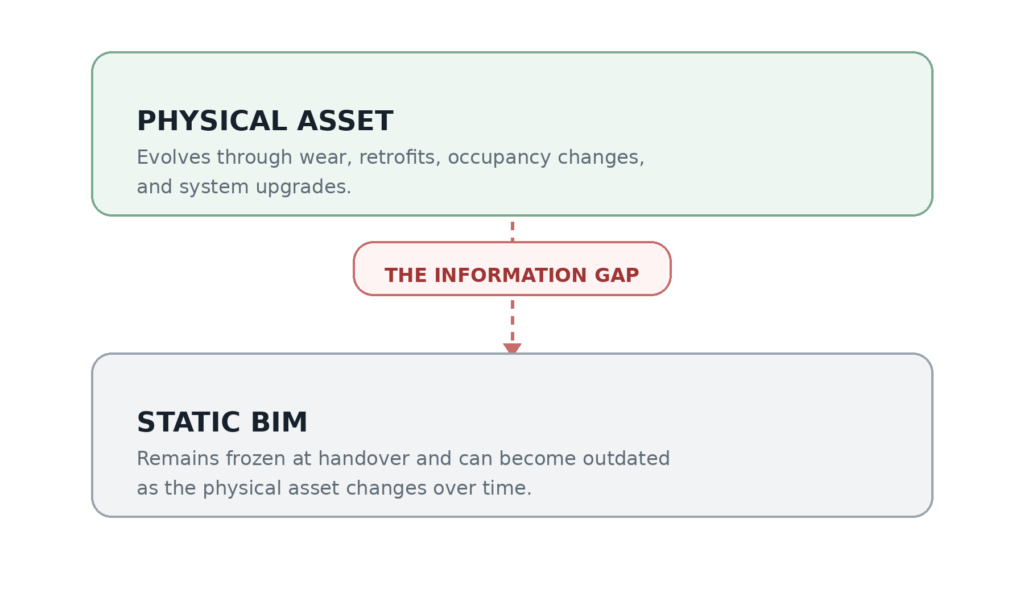
The physical facility evolves continuously, while the digital model remains frozen at the moment of completion.
Digital twins resolve this operational disconnect. As defined by the UK’s National Digital Twin Programme (NDTP) and buildingSMART, a digital twin is a digital representation linked to a physical counterpart through a continuous, two-way exchange of data appropriate to the decisions being made. It changes the executive question from “What can we extract from our design model?” to “What decisions could we improve if our building model reflected live operational realities?”
BIM vs. Digital Twin: Defining the Boundaries
Digital twins do not replace Building Information Modeling; they rely on it. BIM provides the structural, geometric, and classification baseline upon which live data is anchored.
| Dimension | Building Information Modeling (BIM) | Digital Twin Environment |
|---|---|---|
| Primary Focus | Structured design, coordination, and physical specifications. | Dynamic monitoring, operational status, and asset performance. |
| Lifecycle Phase | Heavily weighted toward design, procurement, and construction delivery. | Dedicated to facility operations, maintenance, and lifecycle retrofits. |
| Data Nature | Static snapshot of planned or verified as-built conditions. | Continuously updated time-series telemetry (IoT, BMS, meters). |
| Core Objective | Constructability, clash detection, and statutory documentation. | Anomaly detection, energy optimization, and predictive decision support. |
| Interoperability Scope | OpenBIM (IFC), Revit, and Common Data Environments (CDE). | Multi-system integration: CAFM, IWMS, ERP, SCADA, and GIS. |
Executive Insight : A digital twin is an operational management discipline, not a visual design tool. Purchasing an advanced 3D viewer does not produce a digital twin; value is generated only when live data streams inform specific, quantifiable business decisions.
The 7-Layer Digital Twin Architecture Stack
A functional digital twin should be viewed as an interconnected architecture rather than a single monolithic piece of software:
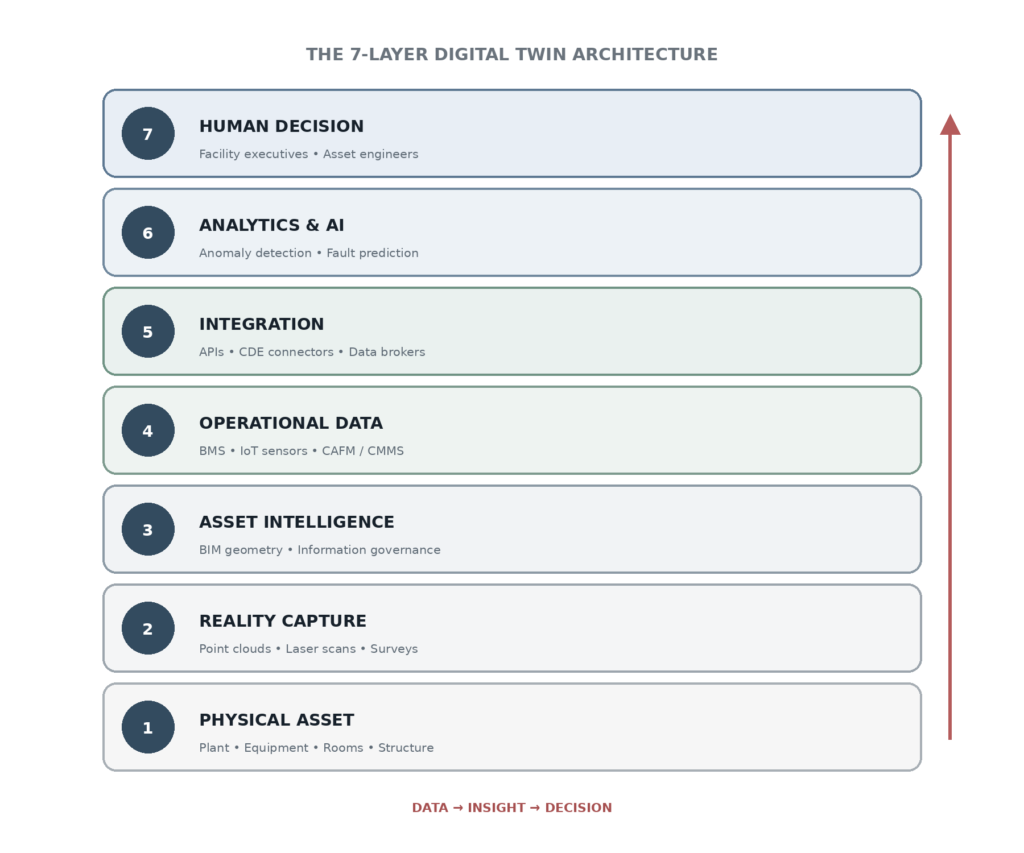
- Physical Asset: The real-world building, civil infrastructure, or mechanical subsystem.
- Reality Capture: Laser scanning, photogrammetry, and spatial surveys documenting true as-built conditions.
- Asset Intelligence (BIM): Structured geometric and alphanumeric data governed by international standards (e.g., ISO 19650-3, COBie).
- Operational Data: Live feeds from Building Management Systems (BMS), sub-meters, ambient IoT sensors, and maintenance logs.
- Integration Layer: Web APIs, open data brokers, and standardized schema (ISO/IEC 30188) enabling cross-platform exchange.
- Analytics and AI: Pattern recognition, automated anomaly detection, simulation, and predictive fault forecasting.
- Human Decision-Making: The facility manager, building operator, or portfolio director who acts upon the derived intelligence.
Business Value: Shifting from Reactive to Predictive Asset Management
The economic return of a digital twin is realized when facility teams stop reacting to failures and start anticipating them:
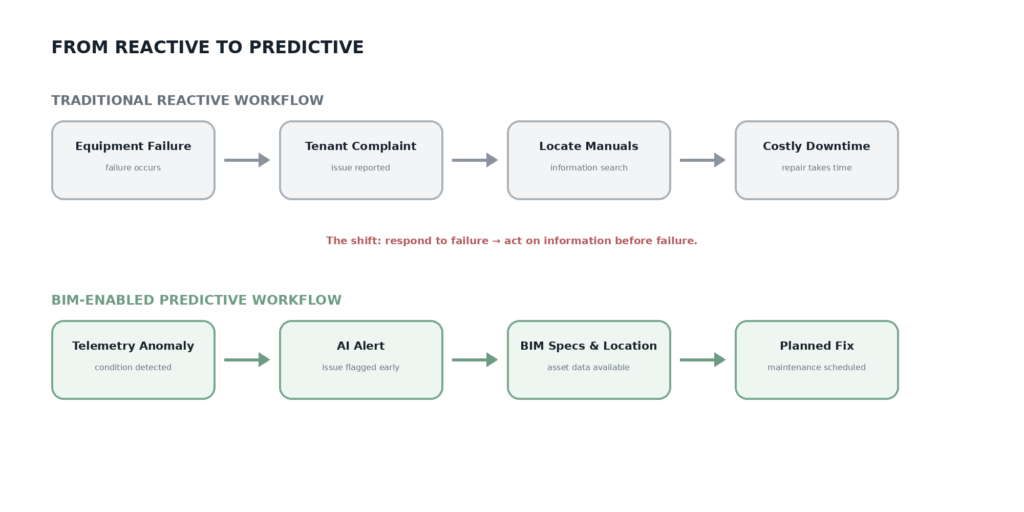
- Targeted Energy Optimization: Correlating occupancy data with HVAC output prevents over-conditioning unoccupied zones, directly lowering utility costs.
- Proactive Maintenance Interventions: Sensor tracking that flags subtle vibration or thermal deviations enables technicians to service equipment before catastrophic failure occurs.
- Streamlined Capital Planning: Real-time run-hour data and actual operational wear replace arbitrary depreciation schedules, allowing for precise equipment replacement planning.
The 5-Level Digital Twin Maturity Model
Organizations do not need to deploy an autonomous, fully connected ecosystem on day one. Capability should develop incrementally:
| Maturity Level | System Characterization | Primary Capabilities & Deliverables |
|---|---|---|
| Level 1: Digital Representation | Descriptive | Verified 3D as-built BIM model reflecting physical geometry and spatial layout. |
| Level 2: Structured Asset Data | Informative | Model components enriched with verified metadata, serial numbers, warranties, and maintenance parameters. |
| Level 3: Connected Twin | Operational | Real-time sensor integration, BMS telemetry, and direct linking to CMMS/CAFM work order systems. |
| Level 4: Analytical Twin | Predictive | Time-series data analytics, fault detection and diagnostics (FDD), and energy anomaly alerts. |
| Level 5: Intelligent Twin | Autonomous / Adaptive | AI-driven autonomous setpoint optimization, automated scenario simulation, and predictive capital forecasting. |
Attempting to implement a Level 5 system without the underlying data structuring of Levels 1 and 2 is the most common reason enterprise digital twin investments stall.
Deploying Digital Twins in Existing Facilities: The Retro-BIM Path
Over 90% of current real estate stock consists of existing structures built without original digital design models. Waiting for new construction is not a requirement for building digital twin capability.
Through Scan-to-BIM and structured reality capture, legacy assets can be onboarded systematically:
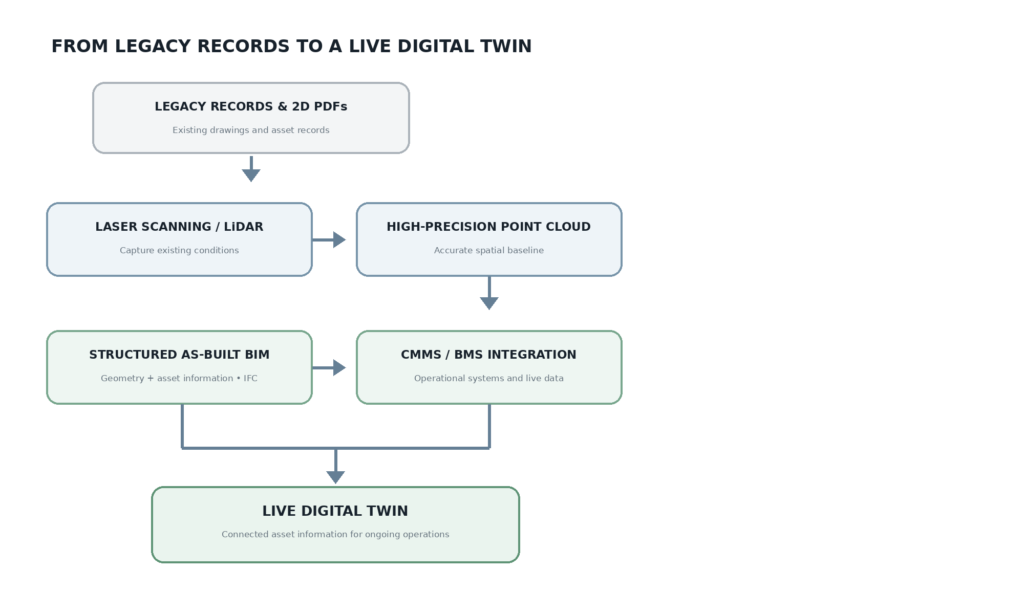
Following the buildingSMART Retro BIM framework, existing physical structures are scanned, converted into clean geometric baselines, enriched with field-verified equipment attributes, and connected to operational telemetry.
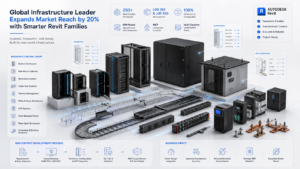
From the ReviCAD Desk: Our development of over 250 parametric Revit families for a global infrastructure products manufacturer demonstrated that geometric accuracy is only half the equation. The greatest business value comes from structuring family parameters so they cleanly survive data exports into operational asset management software. An unstructured model connected to real-time sensors simply produces a high-speed feed of unmanageable data. Information governance must precede sensor deployment.
Interoperability, Open Standards, and Security
Digital twins rely on heterogeneous systems. To avoid vendor lock-in, systems must communicate using vendor-neutral standards:
- ISO/IEC 30173 & ISO/IEC 30188:2026: Establish international terminology, reference architectures, and information exchange requirements for digital twin environments.
- ISO 23386: Provides governance frameworks for defining and maintaining properties in interconnected BIM data dictionaries.
- OpenBIM & IFC (Industry Foundation Classes): Ensure asset geometry and classifications remain accessible across different software ecosystems over decades.
Governance and Cyber-Physical Security
Connecting operational building controls to digital networks introduces physical risks. Digital twin governance frameworks must resolve:
- Role-Based Access Control (RBAC): Defining clear operational boundaries between read-only monitoring and write-access control systems.
- Data Ownership & Longevity: Retaining direct enterprise ownership of building telemetry rather than locking historical performance data inside proprietary cloud platforms.
- Data Sanitization & Integrity: Validating sensor telemetry against trusted bounds to prevent faulty data from skewing predictive maintenance models.
Practical 9-Step Digital Twin Implementation Roadmap
| Step | Phase Action | Core Milestone / Deliverable |
|---|---|---|
| 1 | Define Operational Problem | Prioritize specific pain points (e.g., HVAC downtime, utility surges). |
| 2 | Define Required Data | Isolate only the exact data parameters required to resolve the problem. |
| 3 | Assess Existing Records | Audit available drawings, BIM files, asset registries, and BMS points. |
| 4 | Establish Data Standards | Standardize asset naming, tagging conventions, and ISO 23386 properties. |
| 5 | Build the Digital Baseline | Complete reality capture, model clean-up, and metadata verification. |
| 6 | Connect Operational Systems | Integrate BMS, IoT sub-meters, and CMMS ticketing via APIs. |
| 7 | Deploy Analytics / AI | Activate anomaly detection algorithms once data flows are stable. |
| 8 | Measure Business Outcomes | Audit maintenance cost reductions and energy savings against project KPIs. |
| 9 | Scale Across Portfolio | Replicate tested workflows across additional facilities and assets. |
Frequently Asked Questions
Is a BIM model the same as a digital twin?
No. BIM is a structured approach to generating and managing static digital information about an asset’s design and physical makeup. A digital twin connects that digital data to the physical asset via continuous, real-time data flows to support active operational monitoring and decision-making.
Can a Revit model become a digital twin?
A Revit model serves as an excellent geometric and data foundation, but it is not a digital twin on its own. It must be enriched with standardized asset properties and connected to operational telemetry (BMS, IoT, CMMS) through an integration layer.
Do digital twins always require IoT sensors?
Not necessarily. A Level 2 digital twin focuses on structured asset information linked to maintenance histories, work orders, and statutory compliance without needing live IoT telemetry. Sensor deployment should depend strictly on the targeted use case.
Does AI replace the need for good BIM data?
No. AI output quality depends entirely on the underlying BIM data. Missing parameters, inconsistent naming, and poor classification produce fast but inaccurate results — structured, governed data is a prerequisite, not optional.
Can legacy or older buildings have a digital twin?
Yes. Through reality capture, 3D laser scanning, and Scan-to-BIM modeling, older buildings can be digitized into accurate geometric models, enriched with equipment information, and connected to modern building management systems.
What is the expected ROI of a building digital twin?
ROI is achieved through operational savings: 10–25% reductions in HVAC energy consumption, elimination of unscheduled plant downtime via predictive maintenance, and reduced administrative labor spent searching for legacy O&M records.
Looking Ahead
Digital twins redefine the lifespan of project information. The 3D model is no longer an archival deliverable stored away after practical handover; it becomes an active asset intelligence system that guides operations for decades.
Yet, technology investments only deliver results when supported by sound execution. What happens when organizations invest heavily in digital technology without establishing the necessary operational standards, clear roles, and governance frameworks?
In Chapter 9, we examine the common root causes of digital project failure—and provide business leaders with an actionable blueprint to protect their technology investments before systemic delivery challenges occur.
Key Takeaways
- Beyond 3D Geometry: The true value of a digital twin lies in maintaining a synchronized, two-way relationship between real-world operational performance and digital asset data.
- BIM Is the Foundation: Reliable, ISO 19650-governed BIM models provide the structural baseline required to make IoT telemetry and analytics intelligible.
- Start with Business Problems: Deploy digital twins to solve specific operational challenges (e.g., energy drift, equipment downtime) rather than attempting to model entire assets all at once.
- Brownfield Feasibility: Existing facilities can be transformed into operational digital twins using Scan-to-BIM, reality capture, and systematic data enrichment.
- Open Standards Prevent Lock-in: Adhering to open interoperability frameworks (ISO/IEC 30188, ISO 23386, OpenBIM) protects portfolio data continuity over the building’s full lifecycle.
Sources and Research Notes
- ISO/IEC 30188:2026: Information technology — Digital Twin — Reference Architecture and Data Exchange Mechanisms.
- ISO/IEC 30173: Digital Twin — Concepts and Terminology.
- UK National Digital Twin Programme (NDTP): The Gemini Principles and operational data-sharing frameworks for connected digital twins.
- buildingSMART International: Technical Roadmap for Digital Twins in the Built Environment and Retro-BIM Workflows.
- Autodesk Operational Research (2026): Technical whitepapers covering digital handover protocols, Autodesk Tandem integration, and cloud-connected facility management.
- ReviCAD Applied Project Benchmarks: Multi-discipline Scan-to-BIM deliverables and enterprise parametric Revit family standardization programs.


