






- Part of: The ReviCAD Handbook: Business Value of BIM (2026 Edition)
- Estimated Reading Time: 9-10 minutes
The business value of Building Information Modeling (BIM) extends far beyond creating intelligent 3D models. In 2026, organizations use BIM to improve decision-making, reduce project risk, lower lifecycle costs, enhance collaboration, support digital transformation, and create long-term value throughout the building lifecycle. The greatest return from BIM comes not from the model itself, but from the quality of information it provides to every project stakeholder.
At a Glance: Executive Summary
- Information Management Focus: BIM is no longer just a 3D design technology. Construction’s biggest challenge is managing information, not producing drawings.
- Data-Driven Decisions: Organizations investing in BIM are investing in better, faster business decisions across all project phases.
- Full Lifecycle Return: The real financial return from BIM extends well beyond construction into facilities management, operations, and asset governance (ISO 19650).
- Strategic Advantage: Companies that treat BIM as an enterprise information strategy—operating within a Common Data Environment (CDE)—are better positioned to win bids and protect profit margins in an increasingly digital industry.
Executive Summary
Construction has never been short on complexity. Every project brings together hundreds of people, thousands of decisions, and countless pieces of information that need to stay aligned over months—or sometimes years. Drawings, specifications, schedules, procurement data, revisions, approvals, and asset information all have to move between different disciplines, organizations, and software platforms.
For decades, the industry focused on improving drawings. CAD transformed how those drawings were created, but it didn’t solve the bigger problem: keeping information consistent as projects became larger and more collaborative.
That’s where BIM changed the conversation.
While many people still associate Building Information Modeling with intelligent 3D models, leading organizations now see BIM as something much broader. It has become a framework for managing trusted project information throughout the lifecycle of a built asset—from concept and design through construction, operations, maintenance, and future renovation.
And that’s an important distinction because information, not geometry, is where the greatest business value is created.
What Is the Business Value of BIM?
Before discussing technology, let’s answer the question this guide is built around.
The business value of BIM is the measurable financial, operational, strategic, and lifecycle benefits that organizations gain by managing building information in a structured, collaborative, and data-rich environment.
Unlike traditional drafting or isolated 3D modeling, BIM connects people, processes, and information, enabling better decisions throughout the lifecycle of a project.
Business value typically includes:
| Business Value Dimension | Traditional Output | Strategic Outcome | Example Business Impact / ROI Metric |
|---|---|---|---|
| Financial | 3D Coordinated Models | Reduced rework & fewer change orders | Better cost predictability and protected margins |
| Operational | Clash Detection Reports | Streamlined CDE workflows | Faster approvals and reduced RFI volume |
| Strategic | Higher LOD Models | Stronger digital capability | Higher client confidence & competitive differentiation |
| Lifecycle | Asset Geometry | Operational Digital Twins | Easier renovations & improved facilities management |
| Sustainability | Energy Analysis | Material transparency & carbon tracking | Informed material decisions & ESG objective support |
Executive Insight: Organizations don’t invest in BIM because they need better models. They invest because they need better decisions.
Why This Matters in 2026
The pressures facing today’s construction industry look very different from those of a decade ago.
Projects are becoming more complex. Owners expect greater transparency. Digital delivery requirements and international information standards (such as ISO 19650) continue to evolve. Sustainability is increasingly influencing procurement decisions, and AI is beginning to reshape design, coordination, and project management workflows.
Against this backdrop, fragmented information has become one of the industry’s greatest risks.
BIM helps reduce that risk by creating a common, structured source of project information—a Common Data Environment (CDE)—that can be shared across disciplines and project phases.
Lessons from Practice: One of the first questions clients ask is often about software. Interestingly, software is rarely the biggest challenge. In our experience, organizations struggle far more with inconsistent information, disconnected workflows, unclear ownership of data, and the absence of agreed standards than with the technology itself. Implementing BIM successfully usually begins with improving information management—not purchasing another software license.
Construction Doesn't Have a Drawing Problem
Let’s start with a simple observation.
If you’ve spent enough time working on construction projects, you’ve probably experienced a coordination meeting where every discipline believed they were working from the latest drawings, only to discover that multiple revisions were circulating among different teams. Nobody deliberately ignored the process, and nobody intended to create confusion. Over the course of a project, information simply became fragmented as revisions, markups, emails, and approvals moved between architects, engineers, contractors, consultants, and clients.
This fragmentation is more than an administrative inconvenience. A seemingly minor coordination issue can quickly snowball into a schedule delay, trigger a change order, increase construction costs, and ultimately affect client confidence. In an industry where projects involve hundreds of stakeholders and thousands of interconnected decisions, even small inconsistencies in project information can have significant downstream consequences.
For decades, the construction industry believed its biggest challenge was producing better drawings. In reality, the challenge has always been managing information—ensuring that everyone is working from the same, reliable source of truth throughout the project lifecycle.
That distinction is important because it explains why Building Information Modeling has become so valuable. BIM wasn’t developed simply to produce better drawings; it evolved to help teams manage project information more effectively, enabling better coordination, faster decision-making, and greater confidence throughout design, construction, and operations.
Construction Is More Complex Than Ever
Construction projects have always required collaboration between multiple disciplines, but the scale and complexity of that collaboration have changed dramatically over the last decade. Where a project team might once have consisted of an architect, a structural engineer, a contractor, and a handful of specialist consultants, today’s projects bring together a much broader ecosystem of expertise. Façade consultants, sustainability specialists, fire protection engineers, acoustic consultants, digital delivery managers, prefabrication experts, commissioning teams, facility managers, and, increasingly, data analysts and AI-enabled workflows all contribute to the successful delivery of a modern asset.
At the same time, client expectations have evolved. Owners expect projects to be delivered faster, with greater cost certainty and higher quality. Contractors are under constant pressure to protect shrinking profit margins while managing increasingly complex supply chains. Architects and engineers must balance aesthetics, functionality, sustainability, constructability, compliance, and operational performance—often within the same design decision.
The challenge is that none of these decisions exist in isolation. A seemingly minor modification to the architectural layout can influence structural framing, MEP routing, prefabricated components, construction sequencing, procurement schedules, and even long-term maintenance strategies. As projects become more interconnected, the volume of information that needs to be created, coordinated, validated, and shared grows exponentially.
This is precisely why modern construction is no longer just about designing and constructing buildings. It is about managing information at scale, ensuring that every stakeholder has access to accurate, coordinated, and reliable data throughout the project lifecycle. That shift—from managing drawings to managing information—is one of the primary reasons BIM has become an essential business capability rather than simply another design technology.
Information Has Become One of Construction's Most Valuable Assets
Every construction project generates an extraordinary amount of information long before construction begins. Concept designs evolve into coordinated models, planning approvals become design revisions, specifications are refined, procurement schedules are updated, manufacturers provide product data, cost estimates change, and construction sequences continue to evolve as the project progresses. By the time ground is broken, thousands of decisions have already been made, each supported by documents, models, schedules, calculations, and technical data.
The challenge isn’t creating this information—it’s managing it. On many projects, valuable information becomes scattered across emails, spreadsheets, PDFs, cloud storage platforms, and multiple software applications. Different disciplines may unknowingly work with different versions of the same information, creating inconsistencies that often remain hidden until much later in the project. By then, what started as a simple coordination issue can result in delays, rework, additional costs, or difficult commercial discussions.
In our experience, these problems rarely stem from poor engineering or inadequate design. More often, they’re the result of fragmented information and disconnected workflows. Teams make decisions based on incomplete or outdated data, not because they lack expertise, but because they don’t always have access to the same trusted source of information at the right time.
This is where Building Information Modeling fundamentally changes the way projects are delivered. Rather than treating drawings, schedules, quantities, specifications, and asset data as isolated deliverables, BIM brings them together within a structured digital environment where information can be coordinated, validated, and shared across the entire project team. The model becomes more than a visual representation of a building—it becomes a reliable source of project knowledge that supports informed decision-making throughout design, construction, and operations.
Ultimately, the value of BIM doesn’t lie in the amount of information it stores. Its value lies in making that information accessible, consistent, and trustworthy. When project teams work from the same coordinated information, decisions become faster, risks are easier to identify, and costly misunderstandings become far less common. That’s when information stops being a collection of project files and starts becoming a genuine business asset.
Field Insight: Success Isn’t Measured by the Model common misconceptions about BIM is that its success is measured by the quality or sophistication of the 3D model. While an accurate model is important, it is rarely what clients remember. What clients remember is whether the team was able to make decisions with confidence, resolve issues early, and deliver with certainty. The success of a BIM project is defined by business outcomes, not model complexity.
BIM Has Quietly Changed Its Job Description
BIM Is No Longer Just About Modeling
Fifteen years ago, if you asked someone to describe Building Information Modeling, the answer would probably have been straightforward: ‘It’s a better way to create and coordinate 3D models.’ At the time, that was largely true. Organizations adopted BIM primarily to improve design coordination, visualize projects more effectively, and identify clashes before construction began.
That definition, however, no longer reflects the role BIM plays in modern project delivery.
Today, BIM supports far more than the creation of intelligent geometry. It enables multidisciplinary coordination, automated quantity take-offs, construction sequencing (4D), cost planning (5D), sustainability analysis, reality capture, Scan-to-BIM workflows, digital twins, facility management, asset information management (COBie), cloud-based collaboration, and increasingly, AI-assisted quality assurance and model validation. Each of these capabilities extends BIM’s value beyond design and into construction, operations, and long-term asset management.
The most interesting part isn’t the technology itself—it’s what that technology is trying to achieve. With the exception of 3D modeling, almost every capability listed above is focused on improving how information is managed, shared, and used to support better decisions. In other words, BIM has evolved from being a modeling methodology into an information management strategy that helps organizations reduce uncertainty throughout the lifecycle of a project.
That evolution represents one of the most significant shifts in the construction industry over the past two decades. Organizations are no longer investing in BIM simply because they want better models; they are investing because they recognize that reliable information leads to better coordination, lower risk, more predictable outcomes, and greater long-term value for both projects and built assets.
Executive Insight: The evolution of BIM is not a story about better 3D models. It’s a story about transforming project information into a strategic business asset.
BIM Has Moved from the IT Department to the Boardroom
Not long ago, adopting Building Information Modeling was largely viewed as a technology initiative. Discussions typically focused on software platforms, hardware requirements, licensing costs, and training programs. Organizations wanted to know which BIM software to invest in, how long implementation would take, and whether existing teams could adapt to new workflows. Those considerations remain important, but they are no longer the primary drivers behind BIM adoption.
Today, the conversation has shifted to a much higher level. Business leaders are less concerned about the software itself and more interested in the outcomes it can deliver. Questions that once centered on technology have been replaced by strategic business questions that directly influence profitability, client confidence, operational efficiency, and long-term asset performance.
Instead of asking ‘Which BIM platform should we use?’, leading organizations are asking executive-level business questions:
- Financial & Schedule Risk Mitigation: Will BIM help us reduce project risk, avoid costly site rework, and protect profit margins?
- Winning High-Value Work: Can digital delivery maturity improve our ability to win more complex, high-value projects and RFPs?
- Project Certainty: Will it help us deliver projects with greater predictability, fewer RFIs, and fewer commercial disputes?
- ESG & Sustainability Alignment: How can BIM support carbon tracking, energy modeling, and broader corporate sustainability initiatives?
- Operational Value Creation: Will the information created today continue to generate value during operations and facilities management via Digital Twins?
This shift reflects the growing maturity of the construction industry. BIM is no longer evaluated solely as a design or engineering tool—it is increasingly assessed as a business capability that enables organizations to make better decisions, reduce uncertainty, and deliver more predictable outcomes across the entire building lifecycle.
ReviCAD Perspective: The Real Value Lies in Information, Not the Model
Over the years, we’ve had the opportunity to support architects, engineers, contractors, manufacturers, and developers across projects in North America, Europe, Australia, and the Middle East. While every project has presented its own technical challenges, delivery methods, and software ecosystems, one observation has remained remarkably consistent:
Organizations rarely struggle because they lack BIM software. They struggle because project information becomes fragmented between people, processes, disciplines, and different phases of delivery. Design intent is lost between revisions, stakeholders begin working with different versions of information, and decisions are often made without a complete understanding of their downstream impact. By the time these issues become visible, they have usually evolved into coordination conflicts, construction delays, or costly rework.
This is why we’ve never viewed BIM simply as a modeling methodology. In our experience, its greatest value lies in creating a structured information environment where everyone involved in a project can work with greater confidence, consistency, and transparency. Technology plays an important role, but it is only an enabler. Reliable information is what ultimately improves project outcomes.
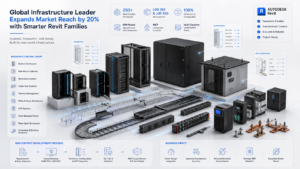
That perspective has been reinforced across many of the projects we’ve delivered. One example involved developing more than 250 parametric Revit families for a global infrastructure products manufacturer. At first glance, the assignment appeared to be a straightforward content creation exercise. In reality, the project’s value had very little to do with geometry. The real objective was to standardize product information so architects, engineers, and consultants could confidently specify, coordinate, and reuse intelligent families across multiple projects.
The outcome extended far beyond producing a library of Revit content. Standardized families helped achieve:
- A 35% reduction in repetitive drafting and modeling cycles across project teams.
- 100% data consistency for architectural specifications, BOQs, and procurement schedules.
- Preserved manufacturer design intent and reliable product data throughout the design process.
It was another reminder that, in BIM, the quality of information often creates significantly more business value than the complexity of the model itself.
That shift in thinking is also changing how organizations define BIM success. For many years, projects were evaluated using technical measures such as the number of clashes detected, the Level of Development (LOD) achieved, or the overall sophistication of the model. While these indicators remain valuable, they no longer provide a complete picture of BIM’s contribution to a project’s success.
Increasingly, owners, contractors, and project leaders are measuring BIM through business outcomes rather than technical outputs:
| Traditional BIM Technical Metrics | Business Outcomes Enabled by BIM |
|---|---|
| Coordinated 3D models | Fewer Requests for Information (RFIs) during construction |
| Clash detection reports | Reduced rework and fewer costly site conflicts |
| Higher Levels of Development (LOD) | Greater confidence in project decisions & risk mitigation |
| Better visualizations | Faster stakeholder approvals and stronger collaboration |
| Faster modeling speed | More predictable project delivery and cost control |
| Complete documentation packages | Better asset information for operations (COBie / FM) |
| Accurate model geometry | Improved lifecycle performance and long-term asset value |
This evolution is perhaps the clearest indication of BIM’s maturity. Organizations are no longer investing in BIM simply to produce better models—they are investing in better project outcomes, more resilient business processes, and information that continues to deliver value long after construction has been completed.
Looking Ahead
Construction is becoming more connected, more data-driven, and more collaborative every year.
Artificial intelligence is beginning to automate repetitive tasks. Digital twins are extending the value of BIM beyond project delivery into real-time facility operations. Owners increasingly expect structured information that remains useful throughout the operational life of an asset.
The organizations that succeed in this environment won’t necessarily be the ones producing the most detailed models. They’ll be the ones that treat information as a strategic business asset.
Because at the end of the day, BIM isn’t really about models. It’s about making better decisions—with greater confidence, less risk, and better outcomes for everyone involved.
In the next chapter, we’ll explore how BIM evolved from a drafting innovation into the digital backbone of modern construction, and why that evolution matters for every organization looking to stay competitive in 2026 and beyond.
Key Takeaways
- Construction’s biggest challenge isn’t creating drawings—it’s managing reliable information across multiple stakeholders.
- BIM has evolved from a design technology into an enterprise business strategy that supports better decision-making throughout the building lifecycle.
- The greatest value of BIM comes from the quality of the information it enables within a Common Data Environment (CDE), not simply the sophistication of the 3D model.
- Organizations increasingly measure BIM by business outcomes such as reduced financial risk, improved profitability, operational efficiency, and long-term asset performance.
- Companies that treat BIM as an information management strategy—aligned with ISO 19650 standards—are better positioned to compete in an increasingly digital construction industry.
